
Meet the Mr. and the Mrs.
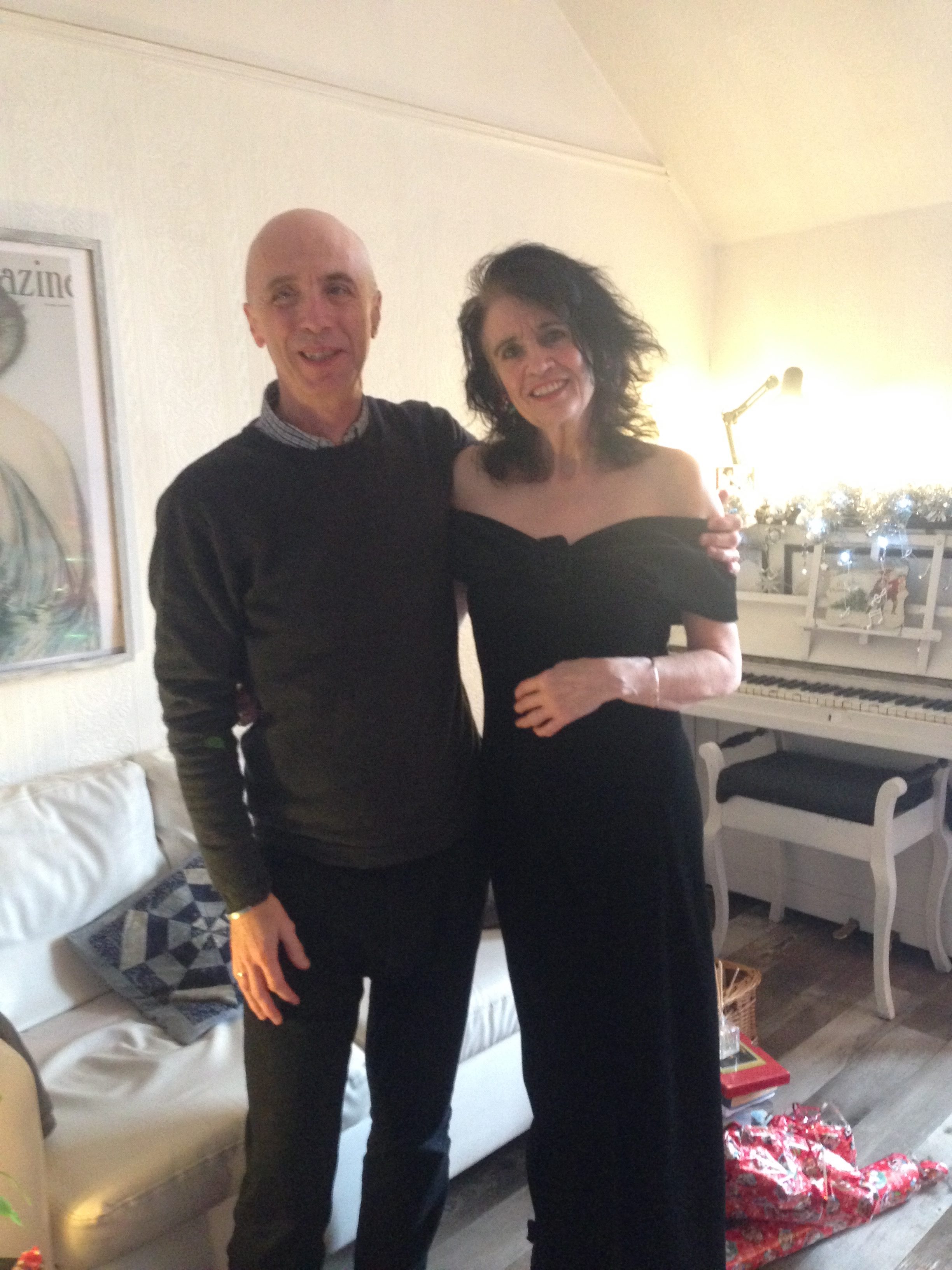
Unless you’re in Hollywood, it’s not often that you come across a husband and wife who both make their living in the arts. My dear friend Shehanne Moore, a/k/a Lady Shey because of her work in writing historical romance, and her husband John Quigly, a/k/a the Mr., which is how the Lady refers to him, both have a passion for creating. For years, Shey labored under a publisher, putting out title after title, only to be told that several of her books had shelf-lives and were soon going to be out of print. So what did this Scottish-born lassie do? Not acquiesce, I can tell you that.
Rather than tow the antagonistic and inhospitable line, she did what any self-respecting woman would do? (Well, maybe not any woman, but as you will note from her writing and her blog, Lady Shey is not just “any” woman.) She pulled all of her books and started her own publishing company, Black Wolf Books. If that sounds drastic and out-on-a-limb crazy, or even the stuff of fiction, well, it’s something all of Shey’s heroines have in common, a sharp mind, more than a bit of the sass, and the ability to turn circumstances to their advantage at a moment’s notice.
Then there’s the Mister, a playwright and director who producers several plays a year.
I had a few questions for Shey and the Mr. which they were happy to answer.

First, Shehanne Moore — Lady Shey:
You’ve got control of your own line of books now that you’ve started your own publishing company. Was that something you felt you had to do or did you just want a new challenge?
It’s something I wanted to do for at least three years, but not only did we move house and that house required a lot of work, we gave a commitment to look after our very wee grandbaby two days a week after his mum got a hard-to-come-by position as a trainee lawyer, one it was vital she took, or she was looking at redoing the actual diploma bit of her degree to the tune of seven thousand pounds. So it went on hold until the moment I learned my books and those of all non-U.S authors had been pulled from our publishers without any warning.
How is being a publisher different from being an author with a publisher standing behind you? Are there fewer or more headaches associated with running your own business?
It is actually far less pressured. Okay it was a steep learning curve in terms of formatting the books for eBook and print, of finding cover images and graphic artists at a reasonable rate. But I did have experience at formatting a magazine. The rest is far preferable to being hit with first round edits Christmas week, or final proofing the day before a book is going live. One of my books sat for over a year after I signed the contract on it before I saw an edit. Another never came out on the day it was meant to because I hadn’t seen an edit, while yet another publisher offered lousy royalty rates and wanted a book as part of a trilogy, every three months. Not that that’s a problem. I’ve done that. But being my own boss means I can work at my pace and release the books at my pace, too. I can also give –well, I hope this is what I am doing – other authors a chance because, yes, I’ve signed some, and I hope our working arrangements aren’t too shoddy either, having sat on both sides of this desk.
You use your native homeland of Scotland as the backdrop in a lot of your stories and you’ve often said that Glencoe is one of your favorite places. Tell us about it and how you use the natural beauty and inspiration of the Scottish Highlands to enhance your novels. What other places have similarly inspired you?

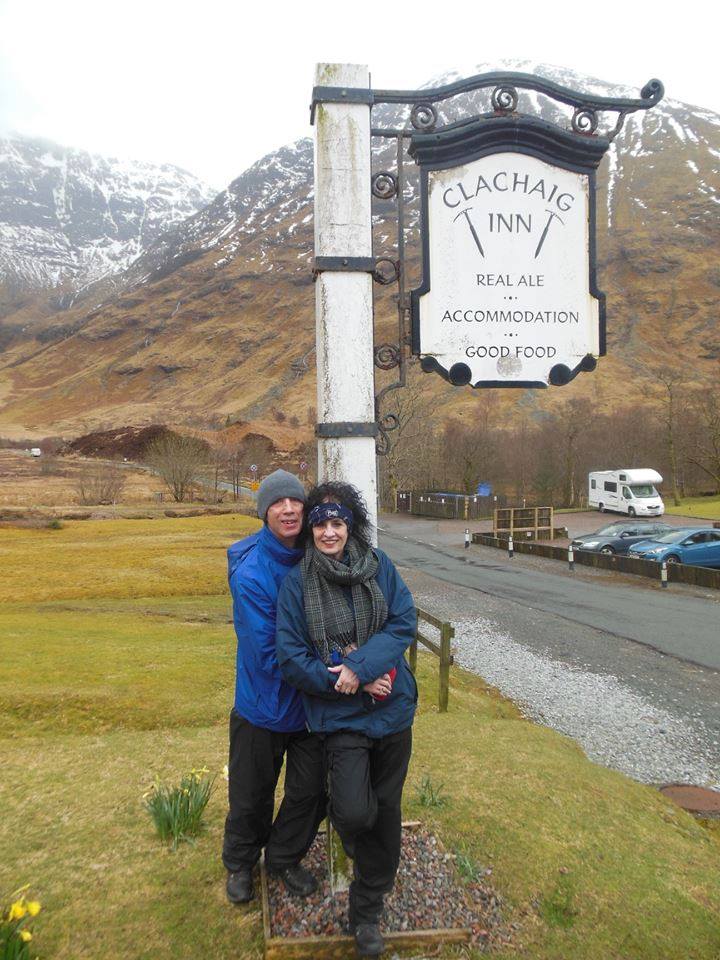
Ooh, lots of places. I squirrel places away. Firstly I do so love Glencoe. I set His Judas Bride there, under a different name. As an area of savage grandeur, moody mountains you can have entirely to yourself, plenty of adventure and the Clachaig Inn to stay in, it’s an area of outstanding, wild beauty. It was also the scene of a massacre in 1692, when Campbell soldiers fell upon their Macdonald hosts on government orders. The glen was pretty much a fortress then, so to come under banners of friendship was the smart way in. I liked the remote, fortress idea and two clans being thorns in each other’s sides. So I used that as well as several areas in Glencoe. But other places have cropped up in my books, too. When we visited the monk’s cell at Mount Grace Priory in Yorkshire, I was so fascinated by it I started thinking where I could use it in a story, and I later did in Loving Lady Lazuli. One bit of His Judas Bride that has nothing to do with Glencoe is the Black Wolf’s cave. That was based on the Cave of the Berkiris which is, in fact, on the Greek island of Spetses.
You’ve described your heroines as “Smexy” — a blend of smart and sexy. Were you the first to coin the term? If so, how did you come up with it? Of all the heroines you’ve written about, who is the smexiest?
I came across it not long after I started out and I rather liked it. I felt it wasn’t outright in your face, this sex. After all sex has been around awhile. And I do like to think of my ladies as smart. Of course, sometimes they’re not so smart when they fall for their men. Yes they stick to certain guns, they’re not weak-kneed, but they can unravel a bit. So I’d say when it comes to the smexiest . . . sorry Fury . . . it’s a toss up between her, and the very unlikely in some ways, and for entirely different reasons, Malice. Both have been at love’s mercy, shall we say, and boy, it’s not happening again.
Why historical romance? What is it about the genre that captivates you?
I have a passion for the past. I have always gravitated towards it in my reading, my viewing and my writing. Let’s face it, there’s plenty of epic events to set stories against. I truly never expected or wanted to write romance though—in fact I had to go take a good look at how to do it. But it was a way in so obviously, I chose historical as my genre.
I was on your blog the other day and I noticed that you’ve created YouTube trailers for your books. First, kudos to you for doing that monumental task and second, how the heck did you do it?! Along those lines, where do you find the models for the covers of your books? Who takes the photos? Is there some Romance Writers stock photo selection that you could go to if you don’t have the resources to create your own cover?
Some of the images in my trailers are my own photographs, otherwise I am looking at what I can find. But the book covers, since I’ve got my rights to my Etopia titles, I buy from a site. Period Images is good, Istock is worth checking. They have many of the same images on Adobe Stock but a hell of a lot cheaper. There’s also Romance Novel Covers. For me, it’s far cheaper to buy the license and then find a graphic designer on Fiverr to mock up a book cover from the image you then download. If I thought the results weren’t okay, I wouldn’t. I’d look at book cover designers, but I did a lot of that initially. When I look on stock image sites I am looking for an image that gives me the book at a glance. And that’s why my books have gone back out in the order they’ve gone back out in.
Can you give us a brief history of The Dudes and how they became a prominent feature on your blog? Do they whisper in your ear when you’re trying to sleep? Have they ever threatened mutiny?
Ah, the dudes. Well, blame then author Antonia Van Zandt. I had written this blog one day about how some aspiring authors, instead of thinking of the story drivers, goal, motivation and conflict, or how character is king, would hit it with everything they can think of, the druids of Stonehenge, the French Revolution, and I was going to put the emancipation of women and I put hamsters for a giggle. Antonia asked me were we going to be seeing hamsters asking to be freed from cages. I said you never know, thinking no way, but hey … the rest was history. And yes, they mutiny every blog post. They make what happened on board the HMS Bounty look tame.
How did you and the Mr. meet? Does your own love story ever find its way into your work?
We met across a copy of a Midsummer Night’s Dream. And no, this is one story that hasn’t found its way, YET.
Do you have any words of wisdom for struggling novelists?
Never give up. Sometimes the hardest thing is to keep believing. But be realistic. By that I mean we all have dreams of finding this and that, the big advance, the fabulous agent, the Hollywood screen deal. Welcome to the back of a very long queue. You will break before you break down any wall that way. Take advice when it’s given, rewrite, rinse, repeat, study the craft, rinse, repeat. Study the market, rinse repeat. I see a lot of self-published books out there that are not for the supposedly targeted market. And if you are submitting, study the requirements, rinse repeat. If you want to hit the mark, any mark in this business, you have to know what it is and have it in your sights.

And now let’s hear from the Mr., John Quinn:
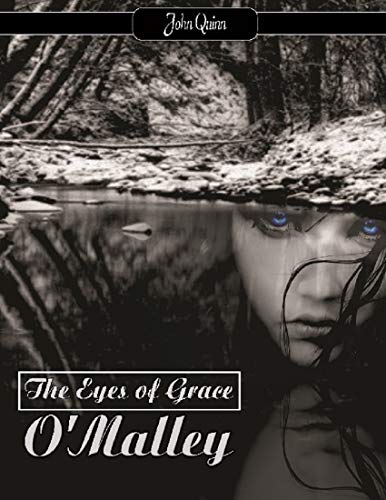
You have one book out, “The Eyes of Grace O’Malley,” which is part love story, part history lesson, set in 1972 in Scotland during the miners strike when the city of Edinburgh was plagued with riots and rolling blackouts. How much research went into that book?
Unbeknownst to me, I researched a lot of it many years ago when I was a student at the University of Edinburgh and lived in the city. I stored things away. But of course, while writing the book I went back many times to walk streets, visits bars, coffee shops, museums, the precincts of the University, etc. I wanted to get a feel for the city again and make it a character in the book almost. Some of the research was done in the National Library of Scotland which figures in the story and Edinburgh City Libraries across the road. I also checked a few minor legal points in terms of Scots Law with my daughter who is a lawyer.
One of the protagonists is Scottish, the other Irish which gives you a lot of leeway to talk about history, heritage and family secrets. Did you draw on any of your own history for the book?
I did. I’m Scots but of (mainly) Irish descent. For example the real Farrell Golden was my great-great grandfather, an Irishman who came to Dundee in the wake of An Gorta Mor (The Famine or Great Hunger). The story is imbued with (albeit fictionalised) autobiographical elements. I was present as a student at a protest in Edinburgh about the shooting of Civil Rights’ marchers in Derry a few days earlier. And I was ‘smuggled’ into Craiglockhart Convent and Catholic Teachers’ Training College during the blackout by my then girlfriend. This was before I met Shehanne Moore of course!!
I knew there was be a story there, John! You say in the foreword to your book that you may never write another book. Most writers are planning their next book before they even finish the last one. What gives? Did you find the novel-writing process more constricting then writing plays?
I was being slightly tongue-in-cheek! In fact I’ve got almost forty thousand words towards another novel set in the present day – like the 1970s turbulent times. It’s also a love story about a man’s former teenage sweetheart who was supposed to be dead, but who re-appears under another name having been very much alive for decades. This time the backdrop is the anti-nuclear movement in Scotland.
I like to try different types of writing. As well as the ‘possible’ second novel I’ve been writing lyrics for songs – I was actually asked to do this by a musician I know. We’re putting together an album of 12 songs which is a charity fund-raiser. And Shehanne Moore wrote the music for 2 of the songs!
Is there nothing you two can’t do? You put on several plays a year and it seems you are intimately involved in all aspects of production. Do you have backers? Where do you get the ideas for so much content? How do you have time for it all? Are you always working on the next play even while you are producing the first one? Have you always been a playwright or was there an occupation precedent?
I’m a former teacher, but I’ve been involved in various types and aspects of theatre over many years. I don’t have backers – the group is informal and called Shoestring Theatre. It’s a bit like street theatre really. What I do have is a lot of brass neck (not sure of the equivalent expression over the pond). The play ‘O Halflins an Hecklers an Weavers an Weemin’ was based on research I’d done into the rich varied (and international) history of our home City Dundee and the Jute Industry which bestrode it for two centuries. Among the things the city is known for are the warmth, directness and mordant humour of the people, and the strength and character of its women. I find plenty of ideas around me in all of that.
How did you and the Lady meet? Does your own love story ever find its way into your work?
I was playing Demetrius in ‘A Midsummer Night’s Dream’ and the woman playing opposite me dropped out with three days to go. In stepped this other woman. We’ve now been together 38 years . . . .
Does your own love story ever find its way into your work?
John – I can’t speak for my wife but my own love story regularly finds its way into my writing.
Nice. Do you have any words of wisdom for struggling playwrights?
I’d hate to be thought of as the fount of all knowledge on playwriting or anything else but it seems to me we learn to write by reading, watching and listening. And drama has to have conflict and pace and variety and passion and (where appropriate) humour.

For the Mr. and the Mrs.:
You both work together on stage to create John’s plays. Do you do the writing together, too?
Shey: No. We don’t write the same things. I think writing is a solitary occupation. And we’d probably kill each other if we had to work together. He’s way too bossy.
John: Shey is the Director who has the vision and ideas about how scenes should be put across.
How is it working with a spouse? Do you have creative differences that lead to a crisis or is one person in charge? And when you do disagree, does that lead to a pervasive quiet at the dinner table or do you easily work through it?
Shey: I think we both agreed when I edited Grace O’Malley that it’s like teaching your spouse to drive. There were operatic moments, but I hope that any things pointed out as needing ‘fixed’ made for a stronger story and were things I had learned from working with publishers, editors and having done editing myself.
John: The Eyes of Grace O’ Malley was licked into shape by Shey as editor. Working with a spouse can, of course, lead to what is euphemistically known as free and frank exchanges of views and opinions. Coming from where we come from – Dundee – we’re both pretty direct and don’t really do ‘pervasive quiet’. That said, my novel would have been nothing without her fine tuning my ideas. However I have, not that I’m aware of, contributed to her story lines.
What other ways do you support each other in your work? Are there any hard feelings when one says to the other “It still needs work.”?
Shey: I think the best way we support each other is by giving each other space. I’m very much the night owl. Mr is the early bird. We each have all our own ideas for whatever we’re doing.
John: We’ve known one another a long time and communicate easily. Having someone I know and trust to edit or direct my work or ask advice of is hugely reassuring to me.
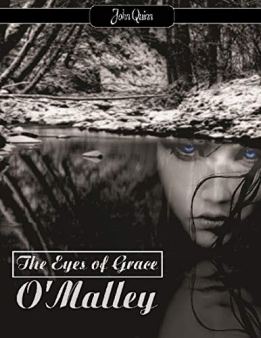
The Eyes of Grace O’Malley by John Quinn
State … Security … Secrets …
Scotland 1972. A turbulent place – miners’ strikes, blackouts, Clyde shipyard workers defying the British Government, oil discovered in the North Sea and the long and deadly arms of conflict in Ireland reaching across the Irish Sea.
Farrell Golden is a bright working class kid from Dundee with an Irish heritage. But he hasn’t always paid it much attention. Thanks to his family he’s made it to the University of Edinburgh against the odds. But does he want to stay there?
There’s beer and there’s women – in particular a beautiful ethereal English girl called Maggie. She’s out of the London stockbroker belt but she’s not all that she seems. Then there’s an Irish girl who is somehow familiar …
Roisin O’Malley’s not like any trainee teacher Farrell’s ever seen. What is she getting away from in Edinburgh? What are her family’s links to the Troubles? What of her ex-boyfriend?
At a Bloody Sunday protest march Farrell sees Roisin in trouble and goes to help. He’s knocked unconscious. When he wakens up he finds he’s stepped down a rabbit hole of Irish history, family ties and state security. Is there a way back? Should he have paid more attention to the family heritage? Who is Roisin O’Malley really?
The Eyes of Grace O’Malley is available Print and eBook- amazon.

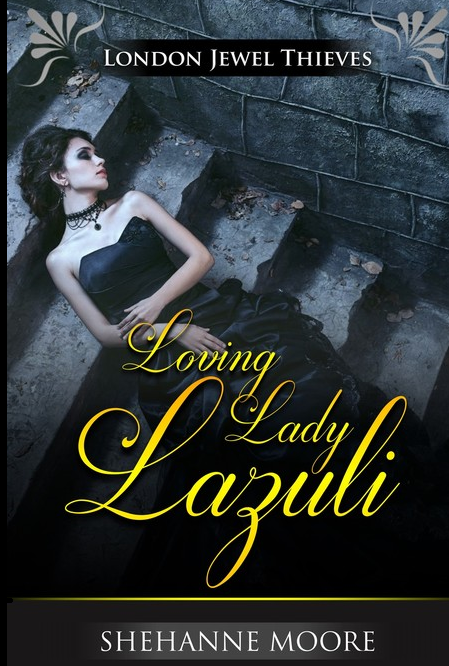
Loving Lady Lazuli – (London Jewel Thieves ) Shehanne Moore
A woman not even the ghost of Sapphire can haunt. A man who knows exactly who she is.
Only one man in England can identify her. Unfortunately he’s living next door.
Ten years ago sixteen year old Sapphire, the greatest jewel thief England has ever known, ruined Lord Devorlane Hawley’s life by planting a stolen necklace on him. Now she’s dead and buried, all Cassidy Armstrong wants is the chance to prove she was never that girl.
But her new neighbor is hell-bent on revenge and his word can bring her down. So when he asks her to be his mistress, or leave the county with a price on her head, Sapphire, who hates being owned, must decide…
What’s left for a woman with nowhere else to go, but to stay exactly where she is?
And hope, that when it comes to neighbors Devorlane Hawley won’t prove to be the one from hell.
Loving Lady Lazuli is available in Print and eBook- amazon.

SPLENDOR – London Jewel Thieves SHEHANNE MOORE
He hates to lose. Especially to a man who’s not.
One move to win ten thousand guineas in a chess competition. One move to marry her fiancé. Another to face the most merciless man in London across a pair of duelling pistols. For Splendor, former skivvy to the London’s premiere jewel thieves, it’s all in a day’s work. But when one wrong move leads to another, can she win and keep her heart intact against the one man in London with the potential to bring her down? Especially in a chess game where the new wager is ten thousand guineas against one night with her.
The Endgame to end all Endgames
One move to pay back his ex-mistress. One move to show the world he doesn’t give a damn he’s been beaten in every way. The ton’s most ruthless heartbreaker, bitter, divorcee, Kendall Winterborne, Earl of Stillmores, pet hates are kitchen maids, marriage and losing. Knowing Splendor has entered a male chess competition under false pretences, he’s in the perfect position to extort her help, regardless of the fact she’s engaged to someone else. He just doesn’t bank on having to face up to his pet hates. Certainly not over the kind of skivvy who ruined his father and set him on this course.
As one move leads to another, one thing’s for certain though. His next move better be fast if he wants to keep the Cinderella he’s fallen for. But the clock is ticking. When it strikes twelve, which man will she choose?
Splendor is available Print and eBook- amazon.
His Judas Bride – Shehanne Moore 
Desiring her could be murder.
If he knew how to stop this, he would
To love, honor, and betray…
To get back her son, she will stop at nothing…
Dire circumstances have forced Kara McGurkie to forget she’s a woman. Dire circumstances force her to swear to love and honor, to help destroy a clan, when it means getting back her son. But when dire circumstances force her to seduce her fiancé’s brother on the eve of the wedding, will the dark secrets she holds and her greatest desire be enough to save her from his powerful allure?
To save his people, neither will he…
Since his wife’s murder, Callm McDunnagh, the Black Wolf of Lochalpin, ruthlessly guards heart and glen from dangerous intruders. But from the moment he first sees Kara he knows he must possess her, even though surrendering to his passion may prove the most dangerous risk of all.
She has nothing left to fear except love itself…
Now only Kara can decide what passion can save or destroy, and who will finally learn the truth of the words… Till death do us part.
His Judas Bride is available print and eBook – amazon.






























 Green Life Blue Water