
Cleanup in Aisle 7
We’ve all heard the term nature abhors a vacuum, meaning nature makes use of all its spaces even if it’s just a space filled with air. We humans have interpreted it a little differently, sadly, and taken things all too literally. Every day we watch the world’s farmland giving way to more development, our forests (the earth’s lungs) being burned and converted to graze cattle and grow coffee beans, our very identities merged with artificial intelligence (thanks, Apple and Alexa), and the rules about what it means to be a human living on planet earth blurring more all the time.
Despite the rhetoric we spout to our kids about playing nice with others, we adults don’t always heed our own advice, especially if there’s something we want, but there are times — generally in crisis — when people of different mindsets do work well together (I hope that doesn’t mean we need an alien invasion to stem the growing tide of populism, but that’s a topic for another blog post.).
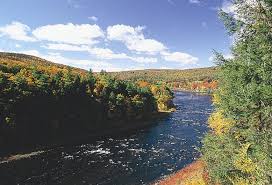
So what a delight to find that there are not only people but entire organizations working well together and on behalf of the environment. The William Penn Foundation in Philadelphia is pumping $42 million into protecting the Delaware River watershed, an enormous amount given over to an enormously important river. The Delaware River Watershed Initiative (DRWI) is a collaboration among 65 non-governmental organizations (NGOs), showcasing the power of partnerships.

The Delaware River provides drinking water for 15 million people as well as shipping for supertankers, fishing for the most enthusiastic fishermen, kayaking, boating, swimming, and other recreational activities. It houses industry along its shores, and preservation for some of its wetlands, all the while being the longest undammed river this side of the Mississippi. Having a coalition to keep the pollution in check, make recommendations for improvements, and monitor water quality, among other things, was the best thing that could have happened to the river. Great things can happen when we lead with science!
So three cheers for the William Penn Foundation. Your benefactor would be proud. Long may the Delaware River flow clean, clear, and unimpeded. Truth is, there’s a lot of work to do to get to clean and clear, but never underestimate the power of commitment.

Back when I was writing Oil and Water, I did my own research on oil spills along the Delaware. I’ll leave you with this little excerpt from the book. Enjoy.
pjlazos 4.16.18
PART TWO
The Delaware River, the longest undammed and only remaining major free-flowing river east of the Mississippi, also lays claim to the largest freshwater port in the world. The river flows three hundred and thirty miles from Hancock, New York, and makes a pit stop in the Delaware Bay before spilling into the Atlantic Ocean. It serves as the dividing line between Pennsylvania and New Jersey and services twenty million residents of the New York, New Jersey and the Philadelphia area with drinking water. Washington’s famous Christmas Eve ping-ponging across the river began and ended on the banks of the Delaware at Trenton, New Jersey. But the river’s abundance isn’t limited to battles, boundary lines and the provision of potable water. It’s a dichotomy in uses: heavy industry draws on her for its needs as do bald eagles and world-class trout fisheries. As evidence of the latter, about one hundred and fifty miles of this magnificent river has been included in the U.S. National Wild and Scenic Rivers System.
In the late 1800s, approximately one million Philadelphians lived within the boundaries of America’s third largest city, which boasted the second largest port in the country located in the Delaware Bay. The U.S. Army Corps of Engineers, the entity charged with assuring the river’s safety, dipped its long, federally-funded fingers into a bevy of construction, flood control, and navigational projects designed to improve, among other things, the river’s navigability. In 1878, before Philadelphia had electricity or the telephone, sixteen hundred foreign trade vessels arrived each year, and six thousand coastal trade vessels docked in the river’s port. Trade vessels have given way to supertankers: seventy million tons of cargo arrive in the river’s waters each year. From sails, to steam, to the supertankers, the Delaware River and its Bay have lent their banks and waters to the growth of the interstate and international commerce of not only Philadelphia, but also the nation.
At its deepest point, the Delaware is only forty feet, which means the river can’t abide a thousand foot supertanker between her banks. Roughly the size of three and a half football fields and bearing three million gallons of oil or other cargo, a ship that size has forty-foot drafts, and sits forty feet below the water line, as deep as the river’s most navigable channel. Low tide causes the water levels in the tidally influenced channel from the Delaware Bay to Philadelphia to drop as much as eight feet which would leave a thousand foot ship incapacitated, floundering like a beached whale.
When the Corps of Engineers began its first deepening project in 1855, the depth of the Delaware stood at eighteen feet. The Corps dredged down to the current depth of forty feet during World War II and maintained this depth by periodic dredging and removal of silt buildup in the channel to the tune of about 3.4 million cubic yards a year. Since 1983, the Corps has studied the feasibility of dredging the Delaware’s main shipping channel down to forty-five feet to better accommodate the world commodities market by making the hundred-and-two mile shipping route from the Delaware Bay to Camden, New Jersey, more accessible.
To do so, the Corps would need to remove about twenty-six million cubic yards of silt and sediment from the river bottom and continue removing another 862,000 cubic yards every year thereafter at a cost of approximately $311 million dollars. Cost notwithstanding, the Corps would need a place to put all that sand, clay, silt and bedrock. While federally owned sites have been identified, environmentalists contend that the detrimental effects to drinking water, aquatic and bird life, and the potential contamination from the disposal of dredged material outweigh the benefits. That story — small town need vs. corporate greed; environmental stewardship vs. environmental recklessness; the rights of the few vs. the rights of society — has existed since the dawn of creation, and, because of constraints of space and time, is a story best saved for another day.
Chapter Thirty-Eight
The Ryujin dropped anchor at Big Stone Anchorage at Slaughter Beach, Delaware, in the mouth of the Delaware Bay. The “parking lot” in the Bay was crowded this morning with a dozen supertankers waiting to offload their cargo onto barges that would take the goods upriver to Marcus Hook or Philadelphia Harbor or Becket Street Terminal in Camden, New Jersey. Once offloaded, the supertankers were light enough to make the trip upriver. Some had been waiting as much as a week while tugs and taxis cruised back and forth, bringing food and supplies to the waiting supertankers, crisscrossing the Bay like a checkerboard and leaving white caps in their wake. The great ships were parked far enough apart to allow them to spin on their anchors, a necessity when considering the vagaries of the weather. From the air it looked like a mechanical ballet: dozens of ships turning and gliding on their axes, a synchronized dance brought to life by the formidable forces of wind and tide.
The Ryujin traveled from the Arabian Gulf and had been parked in the Delaware Bay for the last week, awaiting the offloading of a million gallons of its crude oil onto a barge which would make it light enough to navigate the Delaware’s forty foot channel upriver to the Akanabi refinery in Marcus Hook. While waiting, the Ryujin took on skid loads of food, supplies and mechanical parts sufficient to tide her over until arrival at the next port. And since the suppliers were not interested in receiving credit for these transactions, the Ryujin carried vast quantities of cash to pay for those stores as well as armed guards to protect it. The ship’s superstructure housed a three-story engine room, a machine shop, steam turbine and diesel engines, a mess hall, living facilities for her Captain and crew, and a single cat who relished the job of keeping the mouse population down. Where the mice came from was anyone’s guess given that the ship had spent the last three weeks at sea.
Beside the Ryujin sat the Sea Witch, an engineless barge a third the size of the Ryujin, but with considerably less girth. Motored by The Grape Ape, a seventy-five foot, single-screw, diesel-powered tugboat, the Sea Witch sat, waiting to remove a million gallons of elemental crude oil from the Ryujin and shuttle it up the Delaware River channel for her. Afloat on a tidally influenced body of water, both boats were subject to the fickle, yet predictable, moods of the moon.
Named for the Dragon King of the sea, an important Japanese deity said to have the power to control the ebb and flow of the tides with his large mouth, the Ryujin wasn’t living up to its name today. It seemed that the ocean, the Bay, the moon and the tides were all in cahoots, as the Ryujin spun on its anchor at the wind’s ferocious insistence, and the Sea Witch tried to make amends.
The process of lightering was a tricky one. The tanks needed to be drained one at a time in a specific order, or the Captain would have an imbalanced ship with the bow rising higher into the air as each tank was emptied, a disaster in the making. Therefore, the Captain took great pains to ensure that the oil was skimmed off the top of each of the tanks in a controlled fashion, draining some from one tank, moving on to the next, and back and forth until the process was completed.
After several hours, Captain Heston Reed was barking out orders like a man possessed. There was nothing he could do until the barge, the Sea Witch, had tied on, an event that, despite tidal fluctuations, was close to completion. The fendering bumpers, which consisted of a large piping structure encapsulated by dozens and dozens of tires, and worked like a ball bearing in between the two vessels, were lowered into place, the black scrape marks from previous lightering operations still visible on both ships. With the fendering bumpers properly lined up, Captain Reed gave the command and the Sea Witch’s crew tied on to the Ryujin. The giant mooring ropes creaked and groaned as the crew cranked down on the winches, pulling them tightly into position. Satisfied that the ships had no visible gaps between them, Captain Reed signaled the operator of the Sea Witch and gave the go ahead to his own crew. The crew began the arduous process of lowering a dozen twelve-inch round, rigid rubber pipes down some twenty-five feet onto the deck of the Sea Witch. The pipes were attached by cables to small cranes. The cranes swung them into place, enabling the deckhands to make the mechanical connection to a screw coupling which was part of a larger manifold system on the deck of the Sea Witch and which fed into the barge’s holding tanks. The deck hands inserted the pipes and, using a special wrench and the sheer torque of their body weight, screwed the couplings fast. The rubber pipes originated from a similar manifold system on the deck of the Ryujin, and once Captain Reed and the Sea Witch’s operator were satisfied that all mechanical connections were secured, the transferring, or lightering process, could begin. Captain Reed personally checked each of the connections. The individual pipes were hooked to another, larger pipe so the ship and barge operators could control, via computer, which tank would give and which tank would receive the oil.
Captain Reed gave the signal and the Ryujin began offloading its crude, the oil flowing from its holding tanks through the manifold system and into the pipes that would carry it down to the Sea Witch’s manifold system. The rigid rubber pipes lurched forward as the sudden thrust of oil was released. Frank Charlton, the manifold operator, sat in the control house on the barge electronically directing the distribution of oil into the various holding tanks and taking great pains to keep the ship balanced.
“All right?” Captain Reed stepped into the computer room to ascertain for himself the integrity of the operation. There’d be hell to pay if someone made an error on his ship. Charlton nodded and turned briefly to acknowledge his superior officer. Captain Reed took a deep breath and the corner of his mouth twitched, but he did not smile.
“Let me know when it’s done then. I’m going to see about the pilot.”
“Yes sir, Captain,” Charlton replied without taking his eyes off the computer screen.











































 Green Life Blue Water