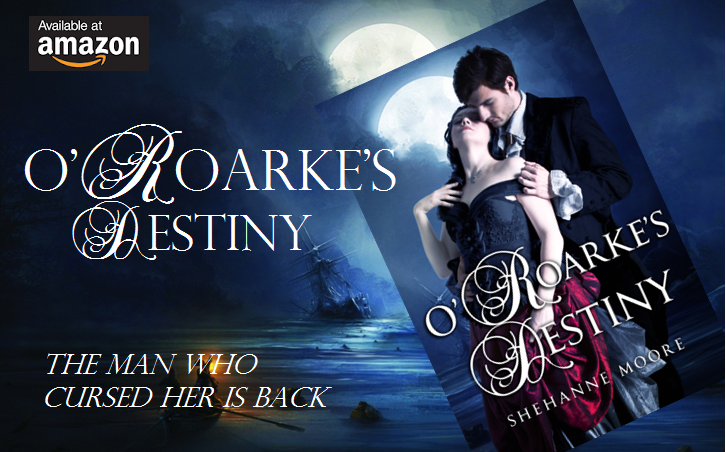
O’Roarke’s Destiny

I asked my friend, the lovely Shehanne Moore, Blogger (Shehanne Moore); Dramatist (performs in productions written by her husband, a playwright); PUBlisher (Black Wolf Books); wife (married to the Mr.); Mother (to her darlings); Grandmother (she’s way too young); avid hiker (the hills of Glencoe in her native Scotland and beyond), keeper of The Dudes (hamsters of the utmost taste and refinement), and, of course, Historical Romance Writer which doesn’t get a parenthetical because it’s the reason we are here today, to celebrate the release of Lady Shey’s new book, her seventh!, entitled, O’Roarke’s Destiny, released on – when else? – Friday the 13th. I mean, hey, if you want to release a book about a couple of characters who are a bit down on their luck, at least for starters, you couldn’t pick a better day, ay?

Smugglers, connivers, and dreamers fill the pages of O’Roarke’s Destiny which you can read all about below, but in the meantime, let’s see what Ms. Moore has to say about the land from which these characters come and how it may have affected their identities.  

Also just as an aside, when Lady Shey’s original publisher changed the rules on her, rules that ran afoul of the long-standing commitment they had both enjoyed to their mutual enrichment and benefit, what did she do?  She didn’t take it lying down, I’ll tell you that.  No sir, she didn’t.  Instead — and just like her heroines she went out and started her own publishing company.  That’s the Kind of Woman we are dealing with here on these pages, not one to be trifled with, put out, or bandied about, a real class act, so without further introduction or delay, let’s hear a bit from the Lady herself about the setting for her new book — Cornwall and the surrounding environs:     

Take it away, Shey:
The Historical Cornish Environment – A Land of Smugglers and Secrets…


A separate people. Throughout the early modern period, many Cornish people continued to regard Cornwall, not as an English county, but as a British country called Kernow.


Physical isolation provides the key to Cornish history. A rocky peninsula, jutting out some 90 miles into the Atlantic Ocean, Cornwall stands at the extreme south-western corner of the British Isles. Surrounded by waves on all sides but one, it is practically severed from the adjoining lands to the east by the River Tamar, which runs almost from sea to sea.


Although mediaeval Cornwall was — technically speaking — an English county just like any other, the culture of the ordinary Cornish people remained entirely different from that of their English neighbours. They still spoke in the Cornish tongue:  a language, closely allied with Welsh. They still prided themselves on being descended from British ancestors, rather than Saxon ones. And, as late as the mid-16th century, they still possessed their own styles of dress, their own folklore, their own naming-customs, their own agricultural practices, and their own games.


The past economy of Cornwall might have been based on a range of industries, including metal mining, fishing, china clay production, wool cloth manufacture, quarrying and shipbuilding. Indeed Cornwalls rich mineral resources may certainly have been exploited on a large scale since mediaeval times, and rows may rage today between surfers, environmentalists, and those bent on lifting the tin tailings sitting on the sea bed to be used in gadgets like cellphones and computers, but Cornwall is also known, historically for another industry, a sort of cottage one in which a rather large number of its inhabitants were once involved.


One that the landscape and environment lent itself to naturally.


Smuggling. 

But the location and the fact the people saw themselves as different werent the only things to lend themselves to the trade. Parts of the actual coastline were very nicely placed for trips to France and the Scillies. Then there was the nature of the terrain, vast empty beaches, rocky caves, jutting headlands, little better than cart tracks for roadsand, as a quick glance at any map of Cornwall will show, quite a big expanse of moor sitting smack in the middle, while the inhabited bits clustered round the coast.  It was nicely private all right. 


At its peak, an estimated 500,000 gallons of French brandy per year were smuggled into Cornish coves. Smuggling has many stereotypes and these images often include a small group of men unloading barrels in the night. However, until the early 1800s, it was a highly organized, well-financed business that was run on very efficient lines.
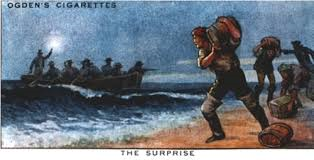
 

Of course, the reason for all this unhindered smuggling wasnt just the highly organized locals, it was the weakness of the excisemen, although in their defence, the  level of local support, the sheer organizational skills of those involved, which frequently included the clergy, the landowners, and other inhabitants, in fact, you name it, and the overwhelming numbers of those involved, made it quite impossible, even for the most dedicated exciseman, to police. So a lot went on right under their noses, in broad daylight.


They were told that if they persisted in trying to make an arrest they would have their brains blown out. As the law now stands, I fear a criminal prosecution would have been useless for the reason, which it shocks me to mention, that a Cornish jury would certainly acquit the smugglers….These, my lord, are the facts.


Did the tramp, tramp of smugglers feet, the alleged digging of tunnels from houses to sea damage the rock, the wildflowers, the beach grasses, the environment? I have no idea.  But I’ve devoured books set both there and further along the south coast, and I felt the ruggedness, the isolation, the crumbling decay of their lives, those that lived there, and I realized that what drove them into this world might lend itself to a book someday.


And it has. Finally. Set in Cornwall at a point when the government was beginning to fight back and seriously crackdown by every means at their disposal, is O’Roarke’s Destiny.  I hope this book trailer roughly explains it. 


Pam, thank you so much, not just for inviting me to your wonderful blog which does so much to highlight the need to look after the planet we share, but for your friendship and support. You should know, you rock. x


Synopsis for O’Roarke’s Destiny:

Once hed have died to possess her, now he just might 

Beautiful, headstrong young widow Destiny Rhodes was every Cornish mans dream. Until Divers ORoarke cursed her with ruin and walked out of Cornwall without a backward glance. Now he’s not only back, he’s just won the only thing that hasnt fallen down about her headher ancestral home. The home, pride demands she throw herself in with, safe in the knowledge of one thing:  Everything she touches withers to dust. 

Hed cursed her with ruin.

Now shed have him live with the spoils of her misfortune.

Though well versed in his dealings with smugglers and dead men, handsome rogue Divers ORoarke is far from sure of his standing with Destiny Rhodes. He had no desire to win her, doesnt want her in his house, but while hes bent on the future, is there one when a passionate and deadly game of bluff ensues with the woman he once cursed? A game where no one and nothing is what it seems. Him most of all. 

And when everything she touches turns to dust, what will be his fate as passion erupts?  Will laying past ghosts come at the highest price of all? 

September 13th2019 Black Wolf Books. Amazon.

Ready to give Shey’s new book a go?  You can get O’Roarke’s Destiny here.  Happy smuggling.

pam lazos 9.18.19

Posted in book excerpt, book release, books, coastal cities, publisher, rivers, romance writer, seas, Uncategorized, writer | Tagged , , , , , , , , , , , , , , , , , , , , | 31 Comments

Material Value

MATERIAL VALUE

The word sustainability seems to be on everyone’s lips these days and if you don’t know what it means then you’ll want to pick up a copy of Julia Goldstein’s book, Material Value, More Sustainable, Less Wasteful Manufacturing of Everything from Cell Phones to Cleaning Products, and treat yourself to an eye-opening panoply of all things recyclable.

Part tutorial, part exposé, part field guide, this wonderful book does all the research so you can sit back and learn how the everyday items we buy are affecting the planet.

Goldstein discusses how goods are manufactured, how we as a society are addicted to wasteful consumerism, and how we all can take steps to reduce waste at the source, thereby improving our world.

She includes interviews with many pioneers in the sustainable manufacturing industry, giving dozens of examples of how various processes can be redirected so as to decrease our carbon footprint and reduce post-consumer waste, conserve virgin resources, and create a robust job market.

Material Value is a must read for consumers, marketers and manufacturers. Simply becoming aware of the waste stream created by each of the industrial products we buy frees us to make better choices at the point of purchase.

Pick up a copy of Material Value and learn how you can reduce your personal pollution contribution in a world that could use some positive environmental mojo.

After reading Julia’s book, I wanted to get her thoughts on a few more things.  This is what she had to say:

What is your hope for this book – other than to be a best seller, of course?

When I hear readers say that the book encouraged them to think carefully before buying a new smartphone or reduce their use of disposable packaging, I see that as a success. I want to spread the message that business and sustainability can and should co-exist by sharing stories of professionals who are making that happen. On a personal level, I hope that publishing Material Value will help me shift my client base toward writing for more companies that are truly embracing responsible actions and want to communicate their efforts honestly to potential customers.

You started your work life as an engineer. How did you get from there to here, an author and content writer for various companies on sustainability issues. Did you burn out on engineering or was writing always your first love?

My standard line is that I was always the engineer writing the project reports and the articles for publication in trade magazines, but there’s more to it. In 2000, I was working on contract in an engineering position that was veering toward project management. I liked the work but couldn’t put in enough hours per week onsite because my 2-year-old refused to nap at preschool. I had to pick him up at noon. Working for a trade magazine gave me the flexible schedule I needed and allowed me to further develop my writing skills. Although my children are now grown, I still appreciate the flexibility of setting my working hours and I enjoy writing. My unique background gives me credibility when I interview engineers because I used to be one of them.

What’s the biggest elephant in the room when it comes to sustainability? How about recycling?

Businesses like to use the word “sustainability” and tout their progress but often neglect to honestly discuss the true impact of their products or manufacturing processes on the environment. They can’t admit that stopping production would be the most environmentally friendly option. Then there’s the love/hate relationship with fossil fuels. We know that fossil fuels pollute and contribute to climate change, but we still want to power our vehicles and homes.

Many of the plastics that people toss into recycling bins don’t actually get recycled into new products. Cross-contaminated mixed plastic waste often ends up in the landfill. We like to give ourselves a pat on the back for recycling when we toss things into the blue bin because that’s easier than facing the reality of dismal plastic recycling rates.

I’m avid about getting plastics out of the ocean and am gathering data to write a plastics recycling law now. If you could write or change one U.S. law dealing with any environmental topic, what would it be?

I would like to end all energy subsidies. Subsidies for solar power got a lot of bad press when thin film solar cell producer Solyndra went bankrupt in 2011 after receiving large federal loans, but the fossil fuel industry has been receiving subsidies for decades. When I asked a question about removing all subsidies at a conference a few years ago, though, the panelists claimed that it would be impossible and not worth pursuing.

Impossible only because no one has done it yet.  It just takes a little vision, right?  So what do you think is most effective at changing behavior: laws; great marketing campaigns; public opinion; public persuasion; or something else?

Laws change behavior, but they often cause resentment. Individuals and businesses tend to complain about being forced to comply. In the absence of restrictive laws, businesses that sell consumer products will change their behavior to keep or gain customers. One example is major beverage manufacturers dropping membership in the Plastics Industry Association this year and moving away from plastic packaging. Public pressure is behind the move.

If you could write the playbook, how would you go about shifting us from the country that uses 37% of the world’s global resources to a net zero waste stream and zero carbon footprint, and is such a scenario even possible?

Achieving zero carbon footprint isn’t possible, even if we returned to a pre-industrial lifestyle, because we would still need to eat. Drastic reductions in emissions are possible but require a monumental shift in national priorities. For one thing, Americans would need to get over their love affair with cars. Electric vehicles aren’t a panacea since they require electricity to manufacture and power them, not to mention the looming battery disposal problem. If the cost of energy (fuel, heating, electricity) increased substantially, that would help incent people to use less of it.

Zero waste to landfill is more doable and also helps with carbon footprint, but it requires a huge investment in recycling and composting facilities along with massive consumer education. We need everyone to buy fewer items, use them longer, repair them when they break, and discard them properly when they have outlived their usefulness. Businesses have the opportunity to lead the way on waste reduction by viewing it as a cost-saving measure. Companies that rely on revenue from frequent repeat purchases will need to rethink their strategy and perhaps make fewer but longer-lasting, more expensive products.

Great advice, Julia.  Thanks so much for taking the time to talk with me and for writing such a useful and informative book.  Great luck with marketing Material Value.  We’ll look forward to a sequel.

pam lazos 9.8.19


Posted in conservation, environment, environmental conservation, environmental effects, evolution, recycling, regeneration, renewable, renewable energy, Sustainability, Uncategorized, upcycling, zero waste | Tagged , , , , , , , , , , , , , , , | 39 Comments

#WATWB — Sailing to America

Sailing to America

How much do I love this kid?  Right now, Greta Thunberg is sailing to America to join the United Nations Climate Change summit, a 3,000 mile trip from Plymouth England to New York.  The journey is somewhat arduous and lacking in such creature comforts as a toilet (she uses a bucket).  She’ll eat freeze-dried food and write in her diary by lamplight over the course of the next two weeks, but her carbon footprint will be ZERO.

Proving a point — yes, of course. It’s not practical for the world to start traveling by sailboat or horse and buggy or other zero waste modes of travel, but for raising awareness for climate change and environmental degradation — priceless!

The Swedish teen’s got detractors aplenty but is undeterred.  Imagine if more members of congress had a portion of her guts and determination, we wouldn’t even be in this environmental pickle!

The flag on the ship says:  Unite Behind the Science.  Really, is there anything else to say?

Want to learn more about the We Are the World Blogfest?  Then go here where my friend Damyanti Biswas will give you the 411 and then you, too, can join the fun!

#WATWB is the last Friday of every month.  See you here next month.

pam lazos 8.30.19

Posted in #WATWB, environment, environmental conservation, environmental effects, Uncategorized | Tagged , , , , , , , , , , , | 27 Comments

Global Bipolar Disorder

Global Bipolar Disorder

Are there any climate change deniers left, other than the current administration, or can we all finally agree that global warming is a problem?  We’re two-thirds of the way through summer here in Central Pennsylvania, but the recent lack of rain has turned my lush garden into an end-of-the-summer-everything-must-go sale while errant leaves flutter to the ground in resignation.  You recognize it in the slant of the sun; there are only so many long, luxurious days at the pool left.  Soon, summer will be but a distant memory, having given way to the real new year — September with its books and backpacks, sports gear and new sneakers.

While PA’s managed to make it through relatively unscathed, the Midwest and Southeast have experienced tsunami-like levels of flooding in places where flooding isn’t generally on the top ten list of worries.  Central PA used to boast a Goldilocks climate:  not too hot, not too cold, but just right. It used to be that if we got snow three times a year the kids were ecstatic, and if we had a handful of above 90 degree days then we’d just be staying at the pool longer.

Alas, those times are gone.  Mother Nature herself seems to be suffering from Global Bipolar Disorder, with her overzealous weather patterns.  But is it really her fault, or can we blame it on our over-reliance on fossil fuels and other non-renewables that are heating us up at our core, and much like someone who suffers from MS, once the core overheats, the whole system is in danger of going down.  If I may borrow from former Secretary of Defense, Donald Rumsfeld:

Reports that say that something hasn’t happened are always interesting to me because as we know, there are known knowns; there are things we know that we know. There are known unknowns; that is to say, there are things that we now know we don’t know. But there are also unknown unknowns – there are things we do not know we don’t know.

If it’s possible to use tortured phraseology and still have a valid point, then Rumsfeld nailed it.  Scariest of all his proffered scenarios are the unknown unknowns: 

known known:  We know the climate is exhibiting variable characteristics at a rate that we’ve not seen for the last several hundred years… 

known unknown:  but that has been determined through core samples to have occurred at some time in the evolution of our species, probably just before the last ice age… 

unknown unknown:  but what the precipitating factors were and when the roof is going to blow off is anybody’s guess.  

We have models, yes, but models in and of themselves are not as predictable as the model makers would have you believe.  If they were, the meteorologists would always be right.  The reason for model inaccuracies, beyond the usual percentage points of variability, is Mother Earth herself.  She knows something’s wrong so she’s put override systems in place, just in case.  While we’re working hard to bury ourselves under fossil fuel fallout, filling the air and water with the detritus, old Gaia is shaking herself free of us like a dog fresh from a bath.  With a typhoon here and a hurricane there, here a wildfire, there a wildfire, everywhere a wildfire… sing along with me.


Fact:  The first decade of the millennium was the warmest on record, and our ability to determine past weather patterns goes back pretty far — about 800,000 years.

Fact:  Increases in rainfall, snowfall, bigger storm events, heat waves, drought conditions, and increased variability are indicative of climate change.

Fact:  The earth’s temperature has increased by more than 1.4 degrees in the last 100 years.  

Fact:  The earth does go through warming and cooling phases, but not at this rate.

Fact:  The sun has not increased its solar energy output (an argument made by climate change critics), which means all fingers are pointing to us humans and our overuse of fossil fuels as the prime suspects.

Fact:  While we need a certain amount of CO2 so plants and trees can do their photosynthesis thing, too much and we choke off our own oxygen flow since the plants can’t keep pace with us. (Perhaps if we clear-cut fewer forests, the ones that make way for raising beef cattle and grew more sustainable products instead, we’d stand a better chance in this department, and now with the Amazon burning…).

Fact:  An increase of 2 degrees F will result in a 5-15% crop reduction; 3-10% increase in rainfall during heavy rainfall events (increasing flooding risk); a 5-10% decrease in streamflow in some river basins; and a 200-400% increase in wildfires.

Fact:  While global temperature has increased by about 1.4% over the last millennium, we are currently heading toward an unthinkable rise of between 2 and 12 degrees by the year 2100.

Fact:  Experiencing extra snowy winters doesn’t mean climate change isn’t real.  Rather, the increased water vapor in the atmosphere results in increased precipitation, a Catch 22. 

Fact:  In the last millennium and a half, global sea level has risen about 9 inches and is expected to rise 1.5 to 3 feet by 2100.  The increase in sea level will force coastal dwellers from their homes, maybe permanently, and if that happens, what the heck will it do to Manhattan?

The instability of the climate means rapid changes unlike anything history has demonstrated, a bipolar disorder of the highest magnitude.  Wildfire, heat waves, polar vortexes, flash floods, and droughts are just some of the lovely surprises that climate change has in store for us.  It’s all about balance, sustainability, inconsistent consistency, the latter which is what normal weather is like — fickle, but not spiteful. 

The Earth was here before and she’ll be here long after we’re gone.  We all know the truth: it’s time for an intervention.  We can help Mother Nature deal with her issues because we are her issues.  The government is not going to save us and neither are the aliens, in case you were wondering.  The only ones who can save us are us.  It’s time to do what we do best as a country — solve problems, innovate, lead so others might follow.  The payoff — as if saving the planet and ourselves wasn’t enough — is that there’s a heck of a lot of money to be made in green technology, but first, we need to cure our global bipolar disorder and think things through in rational, logical terms.

All it takes is a firm commitment, some big thinkers working on long-range solutions, and the marketplace to throw its vision, money, and muscle behind this mission. We can’t win this one, not on the track we’re driving, not without us all working together in the spirit of cooperation to effect a cure. 

Are you in?  

pam lazos 8.25.19

Posted in climate change, congress, ecosystems, environment, environmental effects | Tagged , , , , , , , , , , | 56 Comments

Ch-Ch-Ch-Changes


Cha-Cha-Cha-Changes

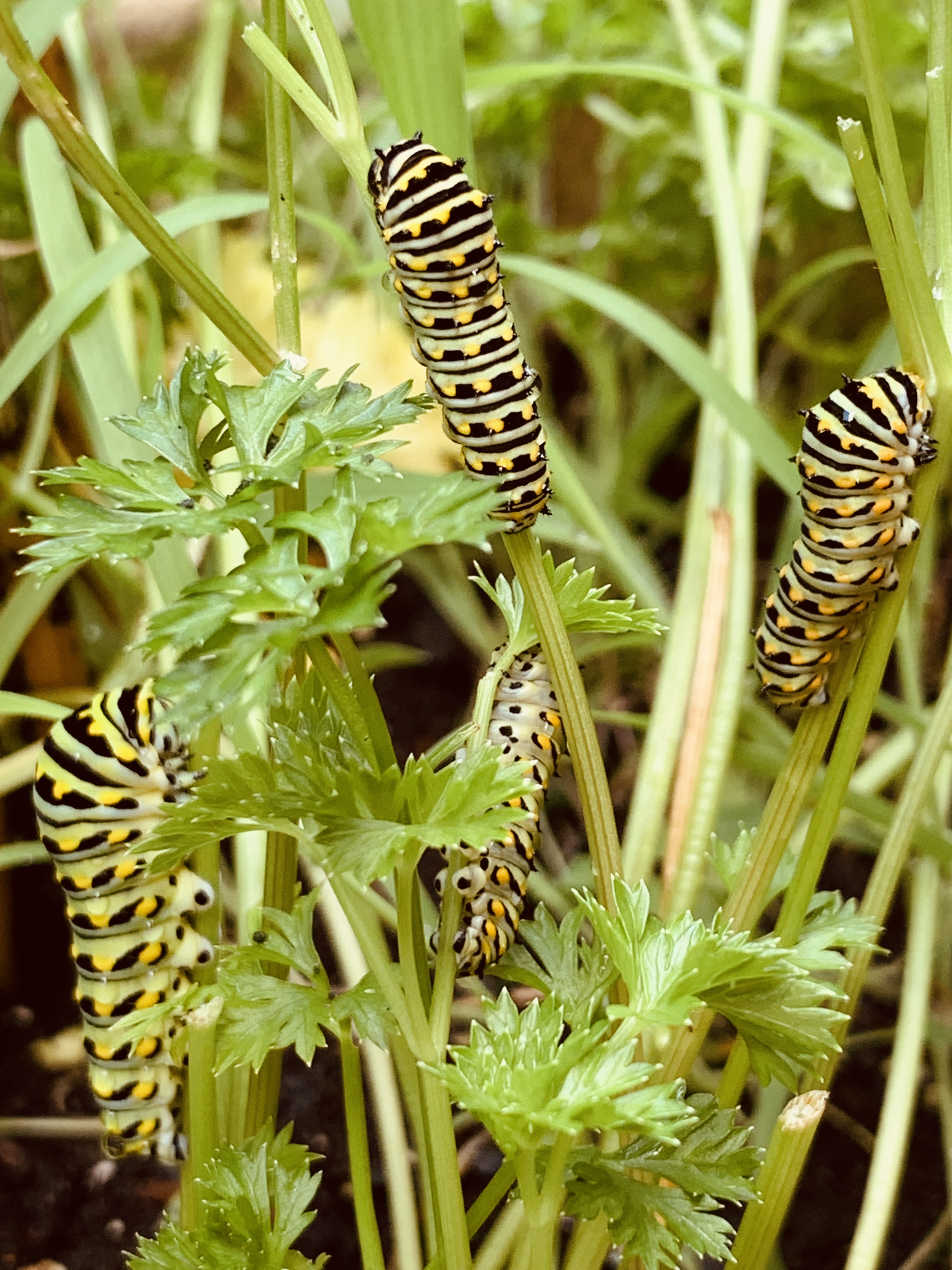
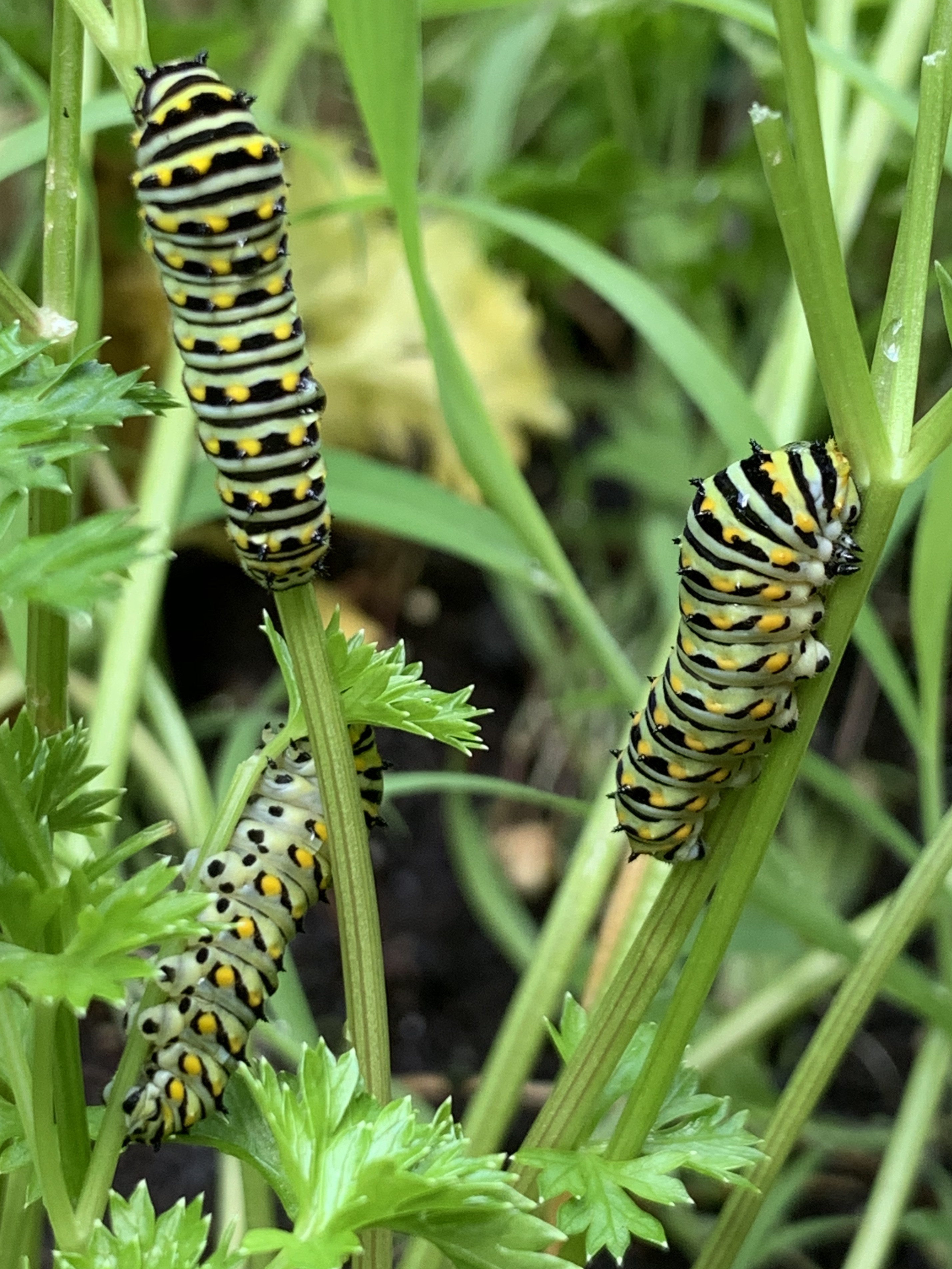
I found these cute little guys attached to the parsley on our back deck.  Imagine spending your entire life in a compact, cylindrical body, your tiny little prolegs protruding from the bottom, your six real legs grabbing onto stalks while you munch munch munch on everything you can lay your real legs on, eating as much as 27,000 times your body weight.

I don’t imagine you can cover much ground with legs like that, but it’s not a forever condition.  In fact, in about a month, they won’t even recognize themselves.

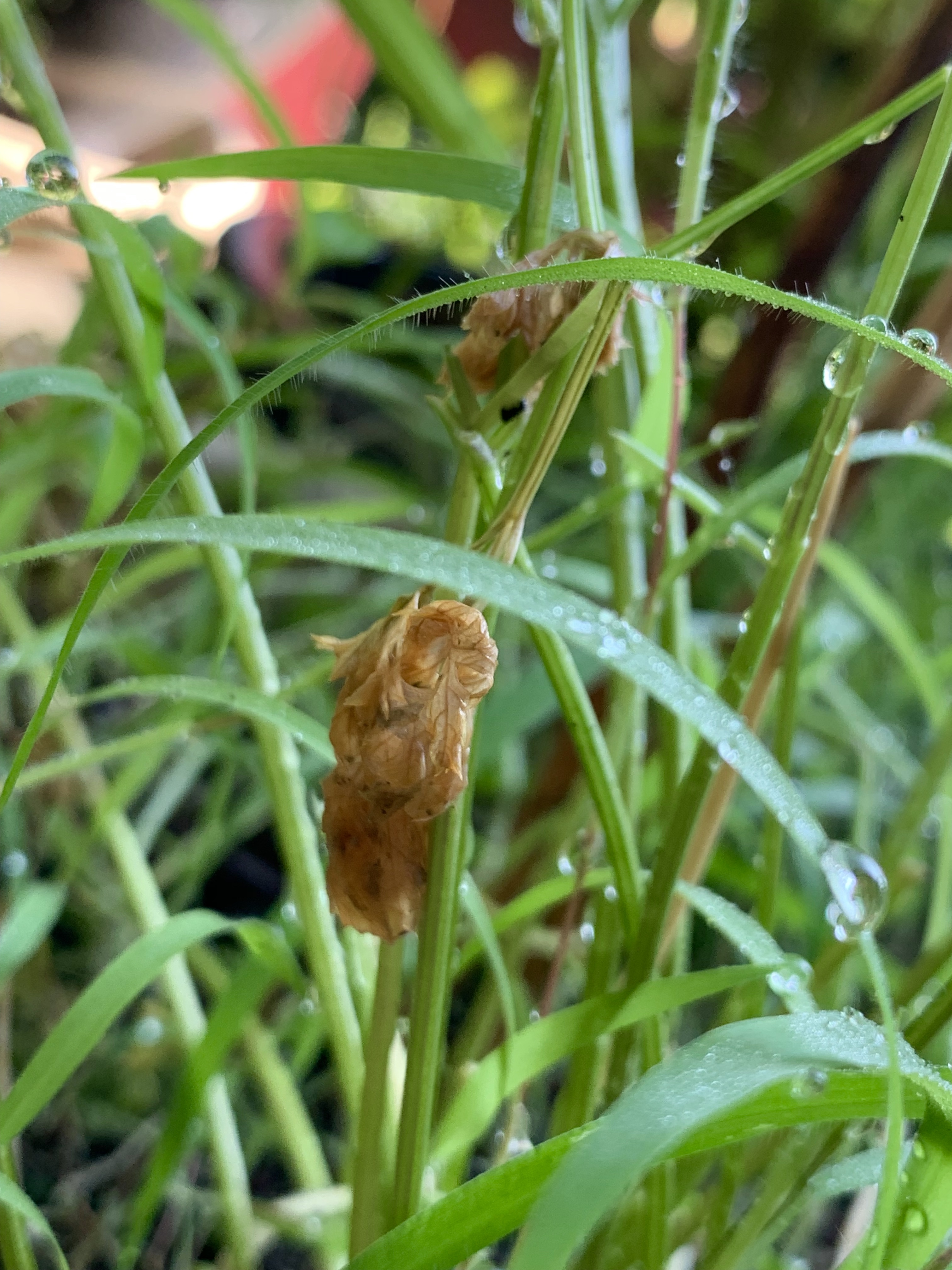
When the day arrives, you get the urge to attach yourself to a stalk and cover yourself in a chrysalis body suit so tight it makes your insides turn to mush. There your stay for some time while your cells rearrange themselves in intricate alien patterns heretofore unknown to you. You wait and wonder, and flail what used to be your little legs while you remain encased in a gauzy haze, resisting the urge to panic, wondering if you will ever be free again. And then, suddenly, you are.

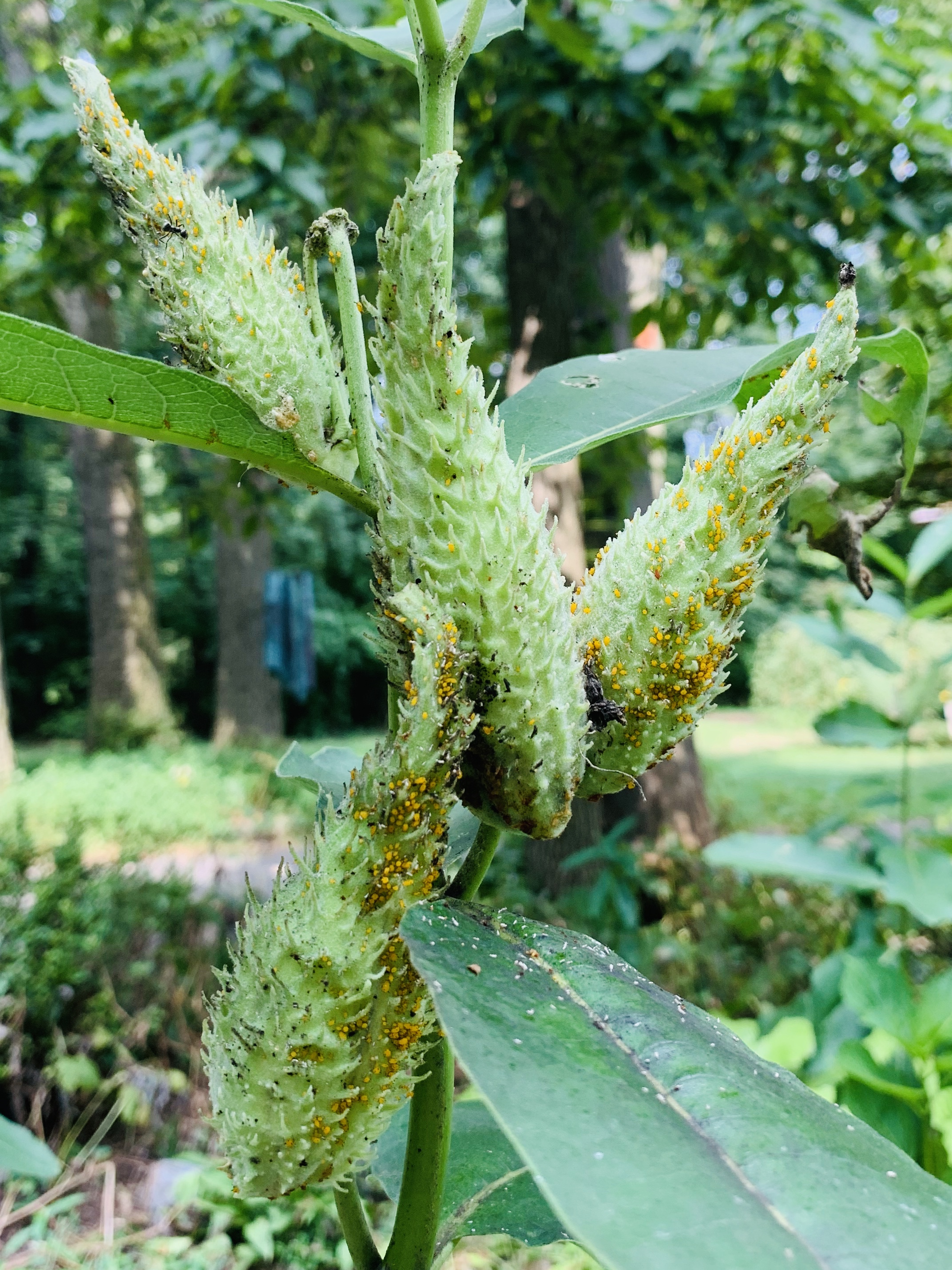
I was excited because I thought these were monarch butterflies in the making.  The monarch butterfly is one of the most iconic representations of Nature’s sublime beauty, and it, like many other species, is endangered, not yet in the legal sense, because the U.S. Fish and Wildlife Service is still conducting its assessment, but in the very real physical sense.

According to the Environmental Working Group, EWG, the monarch butterfly population is down to 20% of what it once was as a result of glyphosate usage – an ingredient in Roundup — an herbicide that kills milkweed, the monarchs plant of choice.

If trends continue, the remaining monarch butterflies may not be enough to resuscitate the species.

Turns out that my little caterpillars were not monarchs, but swallowtails — monarch caterpillars don’t have the yellow dots — and the swallowtails aren’t endangered.  And all my parsley is gone, eaten in one sitting, I presume, but none of that matters.  I was happy to be an Airbnb for a few caterpillars in need of accommodations and I trust they enjoyed their herbicide-free experience.

What can you do to help bring the monarch back?  Plant a little milkweed perhaps?

pam lazos 8.18.19


Posted in butterflies, Roundup, Uncategorized | Tagged , , , , , , , , | 22 Comments

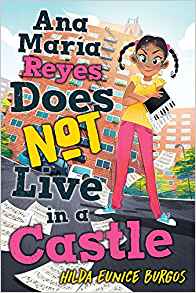
Ana Maria Reyes Does NOT Live in a Castle

Ana Maria Reyes Does NOT Live in a Castle

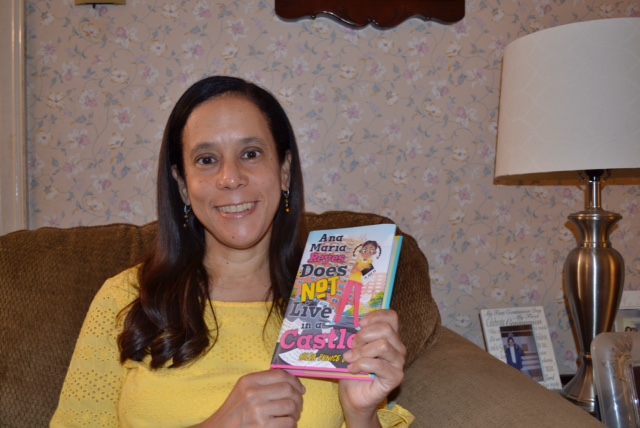
In the category of like attracts like, I seem to have a lot of friends who are writers, which is somewhat odd given the singularity, the isolated nature of such an occupation. My friend, Hilda Burgos, is the author of Ana Maria Reyes Does NOT Live in a Castle.

Hilda and I have been coworkers for almost three decades, hired around the same time, give or take a year, to work at the same federal agency, we’re like sisters in arms, fighting environmental scofflaws and doing our best to save the air and water of our nation.

We also joined Toastmasters around the same time, and for the same reason:  neither one of us were particularly fond of public speaking so if we were going to have to get out there and sell our books we wanted to do it in a coherent fashion, maybe even with a bit of panache.

So while I went the Indie route, self-publishing through Kindle Direct, Hilda found a publisher — and away she went. Ana Maria Reyes Does NOT Live in a Castle is her first book, a YA novel about 13-year old Ana Maria Reyes, a gifted pianist who lives in a crowded apartment in NYC with her stay-at-home mother, lawyer father, and three sisters with a baby on the way. It’s a lovely tale of family and friendship; of what’s important in life (hint: it’s not money); and of working hard to make your dreams come true; for Anna Maria, it’s a scholarship to a prestigious academic school. A sequel is in the works and Hilda reports her publisher is already bugging her for chapters.  So let’s start.

You’re a full-time lawyer with a full caseload, and married with a family which means writing probably falls somewhere down the totem pole of responsibilities.  How do you juggle writing with deadlines from your publisher and what is it about writing that compels you to give up your free time, nights and weekends, to work on your stories?

I’ve always loved to write, and I first started to write children’s stories in earnest after I graduated from law school. It was a fun hobby to do in my free time. But then the kids came along and free time became scarce, so I put it aside. I picked it up again when my daughter was in college and my son was in high school because I had more time and I decided that I should spend that time on what I really enjoy. I’ve always loved language and reading fiction. Constructing my own stories is a fun puzzle that I’m thrilled to conquer.

You are one of four sisters. How much does Ana Maria’s story mimic your own life?

The specific events in the book are fictional, but Ana María’s circumstances and personality are a lot like mine. My parents came to the United States from the Dominican Republic before I was born, and my family lived in an apartment in Washington Heights, New York City. I was always kind of nerdy and really into school. When I was ten years old, I visited the Dominican Republic for the first time ever, just as eleven-year-old Ana María visits the DR for the first time in the book.

That’s awesome.  Do you also play a musical instrument like your character?

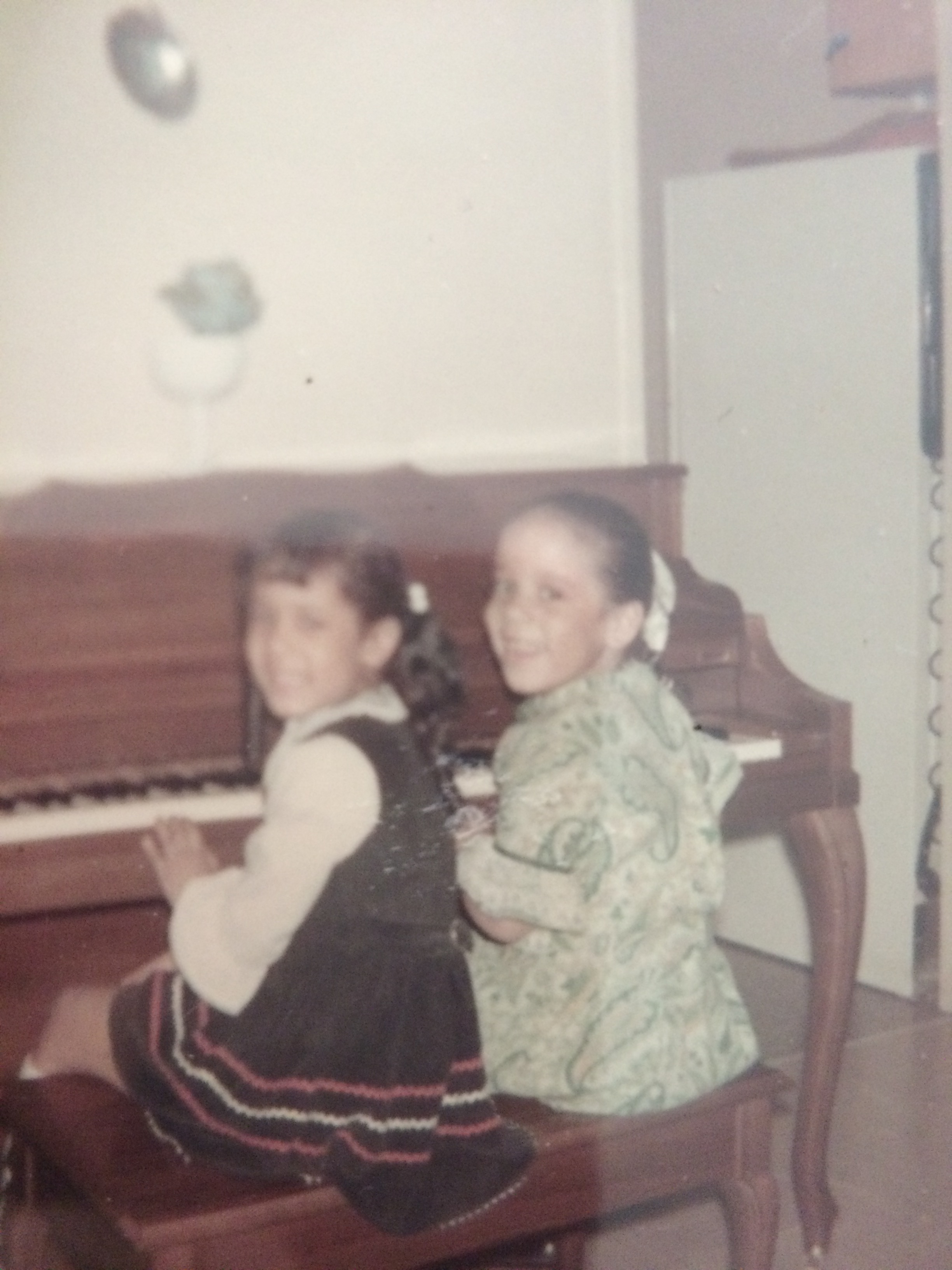
Although I haven’t played in a long time, I took piano lessons for many years as a child. (I wasn’t as good a player as Ana María, though!) 

How did you go about finding a publisher for AMR?  Are you satisfied with the process?  Have you ever considered indie-publishing?

While I was writing the book, I found out that Lee & Low Books was having a contest for middle-grade and young adult books written by first-time authors of color. I submitted my book, and it was selected as one of the five finalists. I did not ultimately win the contest, but Lee & Low offered me a contract anyway. The process has worked well for me because I am very deadline-driven, so I don’t know when I would have finished this book if I hadn’t had a contract with deadlines associated with it! My editor was great and helped me bring out the very best in the book, and now the marketing and publicity people have worked with me to promote the book. Since things worked out with Lee & Low, I didn’t consider other publishers, nor indie-publishing. One good thing about traditional publishing is that you have a whole team beside you to help bolster your product. My book sold over 3,000 copies in the first 3 months, and I certainly couldn’t have done that on my own.

Congratulations on that.  So what draws you to the middle-grade novel as a form of expression as opposed to some other genre?

I am drawn to middle-grade books because they can be a safe place for children to learn about some more challenging issues in life. I like that they can expose readers to thought-provoking themes while also ending with a hopeful and encouraging message. In this way, middle-grade stories teach children that there are tough circumstances out there, but we can deal with them, and we will emerge stronger and wiser when we’re done reading.


The father in Ana Maria Reyes Does NOT Live in a Castle is a lawyer who works for a non-profit that handles a lot of cases dealing with current social issues.  Have you ever considered similar work? What do you think is the most important social issue that our society is grappling with today?

My first job after law school was with a legal aid organization, similar to the one where Ana María’s dad works. It was a tough job, but very rewarding, and I hope that I helped my clients during my time there. One issue that I address in the book is economic inequality because that is a huge problem in our society, which, unfortunately, seems to be getting worse and hurts all of us.

Amen to that.  Tell us about your writing process?  Do you do outlines or just begin and see where that takes you?  What does a perfect writing day look like?

I do a combination of outlining and also just writing and seeing where it takes me. When I have an idea I jot down a few thoughts so they don’t escape me later. Then, when I’m actually writing, the story might take some unexpected twists and turns, and then I have to go in a different direction. Ideally, I would like to have a few days of uninterrupted writing time so I can immerse myself in the world of my story, with the mandatory dog walking breaks to keep my back from cramping up too much.

When you retire, will you devote your time to writing as a second career or do you have other plans?

Yes, I definitely want to write after I retire, and then I hope to never retire from this second career.

I know you are a bit shy by nature.  What do you do to prepare for the book signings and other events where you may be on a panel or asked to speak?

Well, as you know, I’ve joined a Toastmasters club, and that has helped me learn that I’m not going to burst into flames when I get in front of a group of people to speak! I find that being prepared is the best way to give myself the confidence to speak at these events. Also, the more I do it the less intimidating it becomes. (I still can’t say I actually enjoy it, though.)

How many books do you think you have in you?

That’s a great question. I do worry sometimes that I’ll run out of book ideas. However, it seems that each day I think of more and more things to write about, and I wish I had more time to work on my books. Hopefully, I’ll just keep writing books until I’m 100.

In the world of sound bytes and short attention spans, do you think there will always be a place for reading and writing or is writing a dying art form?

I certainly hope it isn’t dying. I’ve noticed that graphic novels and books in verse are more popular now, and I think that might be because they are a little faster to read since they have fewer words. (I’m sure they’re very difficult to write, though.) Still, I have gotten a lot of positive feedback about my book, from both children and adults, and I think (hope) there will always be a place for reading and writing in our world.

There are not that many books out there with a Latina protagonist and while there’s no one way to write a great story, the pressure is on because you are among the first.  How do you feel about trailblazing that path?

Unfortunately, you are absolutely right that there aren’t many middle-grade novels with Latina protagonists, and the problem with this lack of representation is that many people might look at my book and think that this is THE depiction of ALL people like my main character and her family. While I try to ignore that pressure and just tell myself that this is just one story told from one person’s point of view, I can’t help but feel a responsibility to include honest depictions that do not bolster stereotypes. I wanted to make sure that readers realize that Dominicans, like everyone else, are not all exactly alike. So I created a lot of characters who are very different from one another. (I include a list of characters in the beginning so that my readers won’t be confused by the many people in the book.) Even Ana María and her sisters are quite different from one another because that’s how it is in all families, right?

So true.  Sadly, we live in disquieting times where everyone who doesn’t look like us is “other”.  How can books like yours help young adults navigate “otherness” and see that we’re just all people?

A lot of people who are from backgrounds that are different from mine and my characters’ have told me that a number of themes in the book really resonated with them, that they saw their own families in my characters, and that they identified with Ana María so much. I think that’s because a lot of the themes in my book are universal since we all have families that we love (and sometimes hate), we have goals that we work hard for, and sometimes things get in our way and we’re disappointed. I hope that, by seeing themselves in characters who might come from a different background, young readers will learn that we really have a lot more in common than not.

And who do you want to play the movie version of AMR?

I’m not familiar with too many young actors, but, should there ever be a movie version of my book (that would be awesome!), I hope that movie would create opportunities for talented young Latinx actors who may not have had many roles available to them in the past.

Any other thoughts or things you may want to add, you’ve got the pen!

First, thank you for taking the time to read my book, and for these great and thoughtful questions. Writing can be a very solitary venture, but one thing I have learned during this journey is that having a writing community is invaluable and that fellow writers—like you—are the nicest people ever!

Thank you, Hilda. It’s been wonderful speaking with you and reading your most enjoyable story.  Best of luck with Ana Maria Reyes Does NOT Live in a Castle and I wish you all the best with your future writing endeavors!

pamlazos 8.4.19

Posted in book promotion, book release, Uncategorized, writers, writing | Tagged , , , , , , | 31 Comments

WATWB — A Rose By Any Other Name…

A Rose By Any Other Name…

As the Bard reminds us, “A rose by any other name would smell as sweet,” but what could be sweeter than the inspiration that accompanies the aroma?  At the University of Texas at Austin, a wonderful thing is happening:  nature is providing a template for a water purification system of the future and it looks like — a rose.

The scientists at the University of Texas have created a device using a solar steaming system and black paper formed into petal like shapes which, at less than two cents a piece, can collect and purify over half a gallon of water an hour, and it’s both stunning and beautiful to behold.

The device removes any contamination from heavy metals and bacteria, and it removes salt from seawater, producing clean water that meets drinking standard requirements set by the World Health Organization.

A Rose Inspires Smart Way to Collect and Purify Water, UT News, May 29, 2019.

In addition, the design is first of its kind and, it’s portable, which has amazing implications and represents an exciting step forward in dealing with water purification issues in remote areas.  Congratulations to the UT scientists and what a boon for the rest of us!

Welcome to this month’s We Are the World Blogfest, a blogging event created to lift the world to a higher vibration created by Damyanti Biswas and Belinda Witzenhausen.   WATWB showcases stories of hope and light.

This month’s co-hosts are:

Shilpa Garg,
Simon Falk,
Damyanti Biswas
Lizbeth Hartz
Eric Lahti

Go take a peek at their WATWB posts as well as those from other #WATWB and feel your chi rise with each reading!

pamlazos 7.26.19

Posted in clean water, Uncategorized, water purification, WATWB, World Health Organization | Tagged , , , , , , | 29 Comments

Plastic-Free Life Redux: A Story of Independence

[4th of July fireworks over Lancaster]

Plastic-Free Life Redux: A Story of Independence

A couple months ago I sent a letter to the four biggest local grocery stores in my area, espousing the benefits of removing single-use plastic packaging from their myriad array of fresh vegetables. I wasn’t asking them to literally change their whole operating strategy, but to just quit wrapping things that don’t need it in plastic, and to provide reusable bags for the veggies we may want to buy loose, but not too loose; we don’t want them rolling around in our carts and we don’t want to have to put them in paper and contribute to further deforestation of the planet since decimating old growth forests may be even worse than disposing of single-use plastics.

Before I tell you what happened, let me just say that I read a completely unnerving statistic the other day, that is, only two out of ten people consider themselves environmentalists – a mere 20%.  Now maybe it’s me, but we’re in the midst of a sixth global extinction where dozens of species die off daily — up to 1,000 times the background rate as a result of human activity — and yet, only 20% of the population is tuned into that. Por que? Por qua? Say what?! Exsqueeze me?

Does that mean we’re going to blow up in a final brilliant conflagration of CO2 and methane igniting from the spark of some poor bastards e-cig?  And if we’re trying to change the world, is 20% even enough to change anyone’s mind?

Actually, it’s quite possibly as Greg Braden points out in his book, The Isaiah Effect. We only need 1% of a given population to work toward an imagined end in order to change the dynamics in any given area.  But, and it’s a big but, we’re going to need to need more than one percent if we are to not just curtail, but reverse the growing crisis that is climate change.

Anyway, back to the grocery store. Weeks went by and since no responses were forthcoming, I figured it was time for another round of letter writing, and then — a Christmas miracle — I got an email from the assistant manager at Wegmans (located in seven states and growing!), a lovely woman who was happy to report on all that Wegmans was doing in service to the environment.

For example:

— they got rid of plastic straws and just have paper straws now;

— they’ve reduced the amount of seafood arriving in foam containers;

— their uniform shirts are made partially from recycled plastic;

— they are “passionate” about sustainability;

— they have replaced their single-use plastic in NYC (which banned it) with reusable packaging or paper bags;

— they sponsor an event on earth day where you could trade your old single-use plastic bags in for a reusable one; and

— at the front door of every store they have recycling bins for plastic bags, cellphones and batteries.

Pretty impressive, huh? There were other things Wegmans was doing, but I couldn’t write them all down fast enough so this is just a partial list. Anywho — it appears that Wegman’s is on it and getting better everyday so maybe this cultural reconstruction project will be an easier lift then I thought.

What can you do to be cool like Wegmans?   We can all start with a look at our daily consumption of goods and services. By taking a waste-light approach to life we can have an impact on lessening our waste stream, and ultimately, the effects of climate change. Reducing at the source by looking at how we eat, what we shop for, and where we live, to name a few, will give us the freedom of sustainability, allowing us to be truly independent from the tyranny of a waste-filled life.

pam lazos 7.21.19

Posted in climate change, plastic bag, plastics, recycling, sixth extinction, Sustainability, Uncategorized, waste, waste as a resource | Tagged , , , , , , , , , | 33 Comments

Courage

[summer sky © pam lazos]


If you read my original post about The Twelve Virtues of the Merchant Priests, as suggested in the book, Sacred Commerce, my goal was to reflect upon and write about the 12 virtues discussed in the book — honor, loyalty, nobility, virtue, grace, trust, courage, courtesy, gallantry, authority, service, and humility — once a month for an entire year.  The 12 virtues of the merchant priest “automatically lift us to a higher octave of being,” something today’s world is in dire need of, I believe. While I may have missed the once-a-month boat, I’m determined to finish the list even if it takes a couple years. 

Next up:  Courage.


COURAGE

What do you do when everyone you depended on for guidance is gone?

So I am a little kid again, lying in my childhood bed, long awake, with my fears about Infinity intact.  

I can’t sleep because the world is a much bigger thing than even my rambling and wide imagination can wrap its little hands around, and time, because of this Infinity thing, is just downright scary. 

Dad comes in, asks why I’m still awake.  I confess my fears about the world in general, math in specific, because without math, it seems, we wouldn’t have this issue of Infinity.  

I’ve been thinking about Infinity and Heaven together and wonder if I died tomorrow, assuming I even go to Heaven, would I be 10 forever?  And would my baby brother be there, still an infant, or has he grown up a bit?  I want to ask him, but I don’t know where to start.  It’s late and I’m already worried about too much to add his answer to that mix.  Instead, I reach for my dad’s hand, a comforting thing in the dark.  A few tentative words bubble up, gain some confidence, ask their friends to join in creating a sentence.

“Do you think our souls really live forever?”

Yes, I do,” dad says.  “What that looks like though, I have no idea.  Sometimes you just have to have a little faith that it will all work out.”  He squeezes my hand.  “That probably doesn’t make you feel much better right now.”

I don’t know why the answer satisfies me because it’s nothing different than what I’ve already been told, but it’s honest, and he’s my dad; he always makes things better, and even when he can’t, sometimes just holding someone’s hand in the darkness of unknowing is enough to keep the terror on the other side of the door.

Since he’s here, I tell him about a lump on the back of my head where my head and neck meet, but just on the right side.  It wasn’t there yesterday, and I only just noticed it in my insomniac state.  It hurts when I touch it.  I worry that it means I’m going to die, but I don’t want to hear the answer to that question either so I say nothing more.  Dad rubs it for me.  

“So you think you might have a brain tumor and are going to die?”  

I nod.  The man is downright prescient.  He chuckles, rubs the lump again.  The pain disperses, not entirely, but enough.

“You’re fine.  It’ll be gone tomorrow.”  He leans over, kisses my forehead.  “But you need to stop worrying and go to sleep.”

The next day the lump is gone.  

Was it the power of positive thinking?  The law of attraction?  A lymph node that drained during the night — one where I slept soundly because my dad told me Infinity would work itself out without my help? My complete and utter belief in anything my dad says?

It doesn’t matter because it’s a new day, the sun is shining, and I’m only 10.

Fast forward decades.  I’m a mom, among other things, answering the same kind of obscure questions from my kids, but I am unable to answer the biggest one: 

What do you do when everyone you depended on for guidance is gone?  

I say this:  

There exists in nature a remedy for every malady.  

The answers have always been inside you.

Have the courage to become that which you seek.  

And if that doesn’t work, you can always dial me up on the other side. 

pam lazos 7.14.19

Posted in Uncategorized | 28 Comments

Economies of Scale – #WATWB

Economies of Scale

A couple lawyer friends and I have decided to meet weekly to talk about plastics recycling. Ever since I was in law school, so many moons ago, I’ve been thinking about this issue and am disappointed that our government still hasn’t taken it on.  So we’re going to draft a little recycling bill and see what happens next.

Now before you go rolling your eyes 🙄 about already having too many laws on the books, let me just say this about that. Nobody in business ever does anything just to be nice. If there’s no ROI – return on investment – then it’s not going to happen no matter how much of a goody do-gooder is in charge. Even Ben and Jerry’s wants to see a profit.

So how do you convince people that plastics recycling is important, probably on the top ten list of important things if we are ever going to reverse the dire predictions of doom and gloom that have come to depict 21st century society?

Without a recycling law, you don’t.  And here’s another fun fact:  a law with no enforcement authority is just a suggestion, and we are way past the time for that kind of experiment.

The typical definition of economy of scale is “a proportional saving in cost gained by an increased level of production,” meaning, for example, the more widgets you make the less they cost to make because all your set up costs will be incurred only once. What if we turned this concept on its side and applied it to recycling? What would that look like?

Well, for starters, virgin products would cost more than recycled ones — because of a tax scheme, of course — which would encourage business to buy recycled plastics. For such a big change to work, though, the government has to be involved because they are the only ones who can write laws and make people pay taxes.

On the island of Dominica, the government is not only banning some single use plastics like straws, utensils, plates and styrofoam, but they are also making their island climate-change ready by burying utility lines and generally increasing the island’s sustainable nature.  Why are they taking such extraordinary measures?  Well, a year after Hurricane Maria, Dominica is still working through the aftermath and the rubble.  They see the future and it looks like more of the same so they are taking steps to ensure the next hurricane doesn’t wipe them out for good.

What if we could get a few other countries to follow their lead?  Maybe we could make a dent in this climate change crisis thing coming in hard and fast.  Let’s get our economies of scale hats on and find a way to make recycling profitable for the consumers, manufacturers, recyclers and end users.  If the tiny island of Dominica can do it, so can the rest of us.

I’ve created this post for the monthly We Are the World Blogfest.

Our co-hosts for this month’s #WATWB are:
Sylvia McGrath,
Susan Scott,
Shilpa Garg,
Eric Lahti,
and Belinda Witzenhausen.  Please head over to their pages and read awhile.

pam lazos 6.29.19

Posted in Uncategorized | 35 Comments