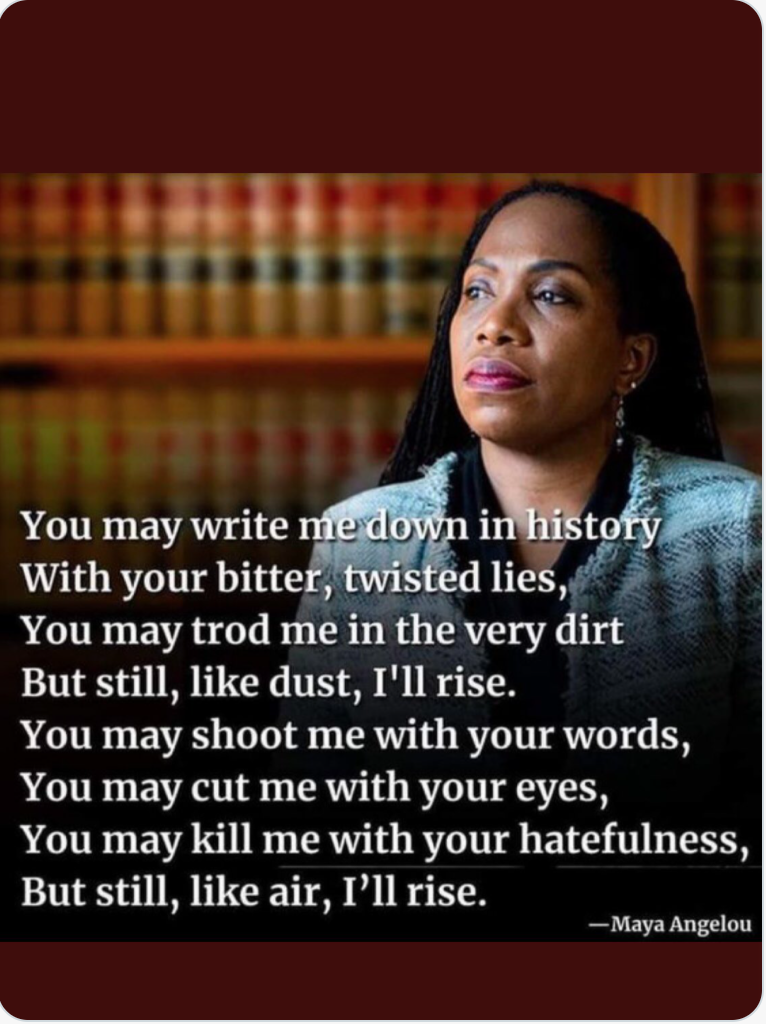
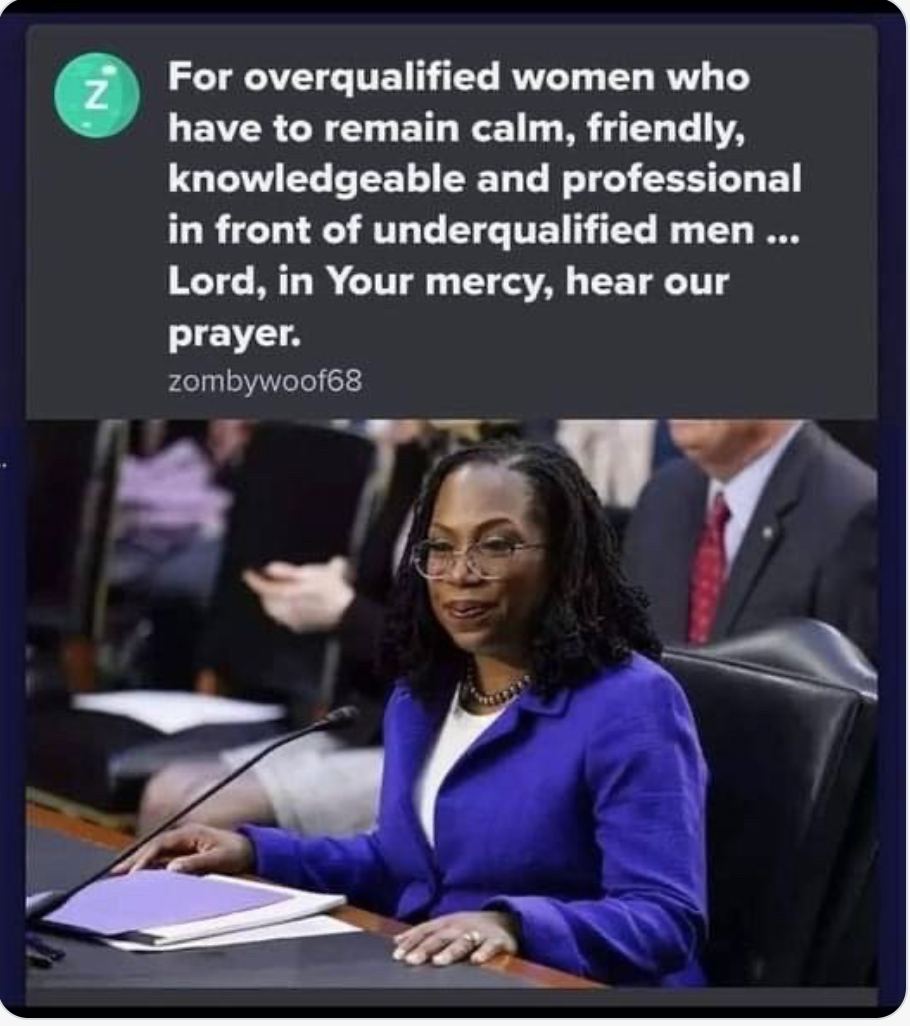
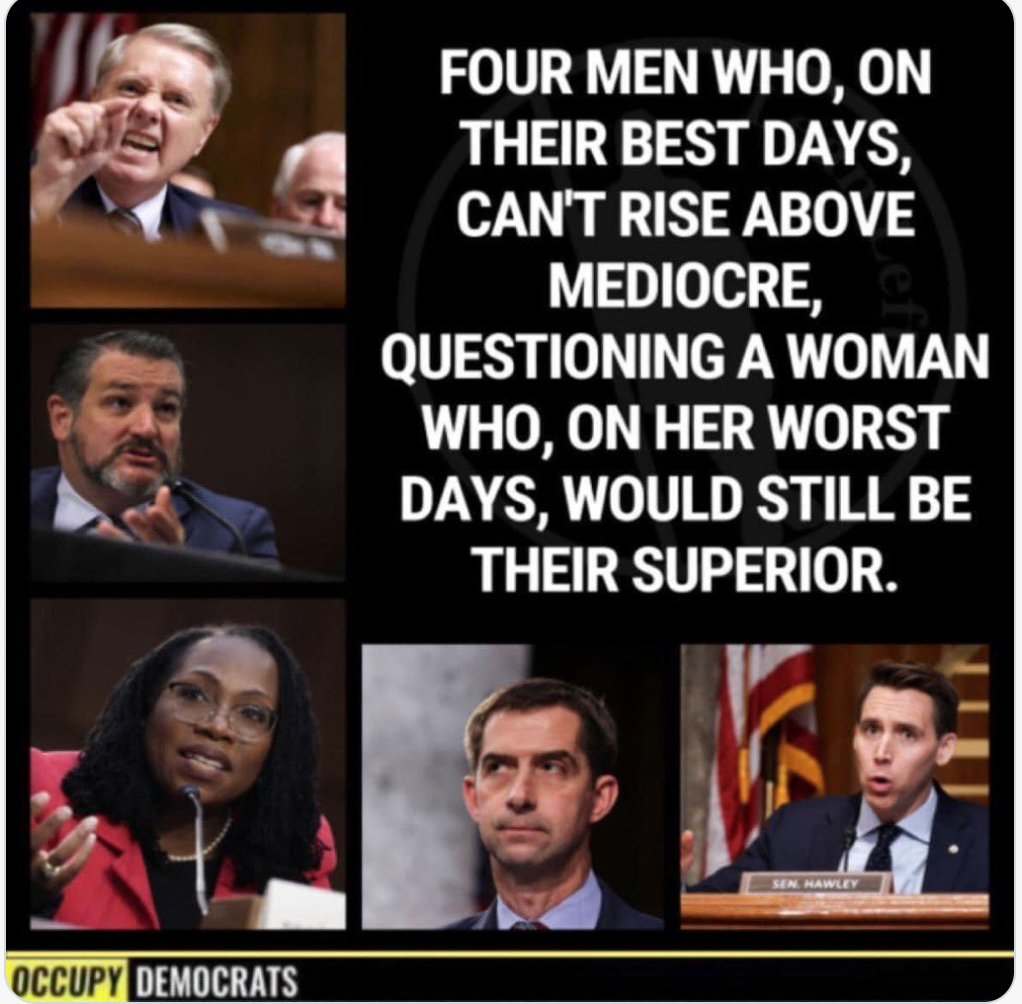
Kentanji Brown Jackson’s nomination hearings are over, but much like the merchant priests of old, Ms. Jackson’s resonance remains.
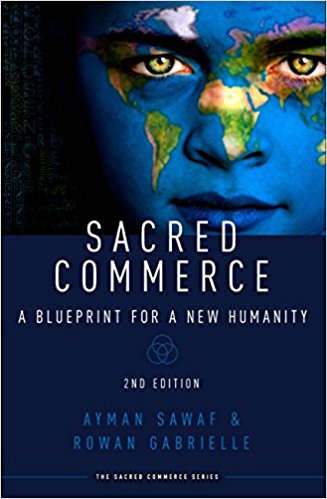
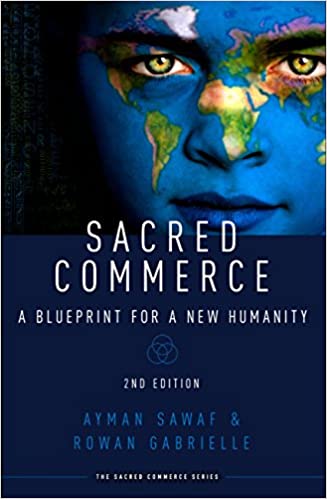
If you follow my blog, you know that I’ve been working through the twelve qualities of the merchant priests, as discussed in the book, Sacred Commerce, for some years now. Sacred Commerce discusses the skill of the ancient priests who could lift the mood of an entire marketplace simply by elevating their own vibrations. The skill took years to perfect through meditation and conscious creation and was based upon three elements of the Soul: beauty, truth and goodness.
The merchant priests drew sustenance from these concepts, meditating on them and incorporating them into their activities of daily living. By doing so, they were not only themselves elevated, but were able to elevate the entire place of business, expanding their own energy and sending that positivity out into the world much like a tuning fork resonates with another when struck. In ancient times, life was base and chaotic, marked by fear and a whole range of lower emotions that lived side-by-side with people’s survival instincts — actually, kind of like today if the legislature is any indication.
Imagine having someone who could elevate the thoughts of everyone around them simply by holding a higher vibration? As the merchant priests focused upon the concept of beauty, perhaps sitting off to the side in an open air market, their entire aura shifted and they were able to spread a supercharged energy to everyone around them. This in turn brought out the principles of democracy, emotional intelligence, fairness and conscious commercialism as a means not just to sell items, but to bring out the best qualities in everyone at market, making every transaction a brush with the Divine Feminine.
In thinking about humility, the final virtue after honor, loyalty, nobility, virtue, grace, trust, courage, courtesy, gallantry, authority, and service, and after listening to the base and baseless questioning of Ketanji Brown Jackson by certain Senators who are responsible for writing the laws of this country — something, apparently, they sometimes forget — I was struck by the analogy to ancient times and how KBJ is much like the merchant priests of the ancient marketplace.
This, then, is the final sacred quality of the merchant priests:
Humility
Humility sits with folded hands and steady eyes, a thoughtful half-smile on her lips. Her husband, daughters, and a lifetime of achievement sit behind, providing her a pillar of undeniable strength like the pillars of the Parthenon in Ancient Greece where democracy got its start, and the center section of the Supreme Court building where inscribed upon the architrave are the words “Equal Justice Under Law”. Humility knows all of those pillars are essential to her own structure, and that the sacrifices she’s made in simultaneously raising a family and pursuing her legal career required compromises that she’s still trying to square.
No one said life would be easy.
Humility is not loud and boisterous, but studious and thoughtful. Humility knows her own mind and keeps her own counsel. She knows when not to take the bait, yet doesn’t retreat from a challenge. Humility smiles a lot as if she knows something the rest of us do not. Humility knows the pride and joy she brings to Black women — to all women, actually — not just by being the first Black woman to be nominated to the Supreme Court, but because of the tools within which she cloaks herself: intellect, diplomacy, mastery of the issues; thoughtfulness, compassion, and so much grace.
Humility wishes that some of the issues that tear men and women down — issues like voter suppression, the crushing reversal of women’s rights, and the existential threat of climate change — were in the rearview mirror, but 19th century values are alive and thriving in a flailing 21st century, overshadowed by patriarchy and greatly divided by ego, power and greed.
Humility has trod these streets before, but she doesn’t worry. She knows where she’s going and what to say to those who would reduce her to the color of her skin. Humility knows how to self-soothe even when the unjust criticisms fall like acid rain. She answers the same questions again and again, each time refusing to react negatively — even temper tantrums don’t rile her — because that would risk throwing it all away.
Humility’s super power is knowing that what she puts her attention on is what she will get more of so she puts her attention on the light and turns her back on the darkness that wants so desperately to swallow her whole. Even the darkness recognizes Humility’s brilliance.
Humility is a tremendous listener and a wonderful coalition builder; she knows listening will move us forward. Humility seeks peace. Humility knows how not to let the message get lost in the chaos. Her focus is surreal, her patience stunning. Humility may bend, but she will never break. Inside Humility’s heart of gold is a core of steel.
Humility — may she rise higher and higher in service to us all.
Three plus decades ago, my Aunt Marylou gave me two black dresses, both sheaths, both high-quality knit — if I had to guess, a blend of linen and cotton — one long sleeve and one sleeveless, the perfect little black dresses every woman needs in her closet. While not part of my daily wardrobe, I’ve worn them dozens of times over the years when I have a fancy party or a somber occasion. I’ve purchased many little black dresses in the interim and you know what? I don’t have a single one of them, but I still have, and wear, Aunt Marylou’s dresses.
Aunt Marylou was herself an amazing seamstress, but she worked as a sewing machinist in a factory making batch items for larger pieces — way before Zara, arguably the creator of fast fashion, pushed the business to multi-billion dollar levels — and because Aunt Marylou knew quality clothing and was also a style icon, she only bought the best. The two little black dresses she gifted me are handmade, easily over 60 years old, and still look marvelous.
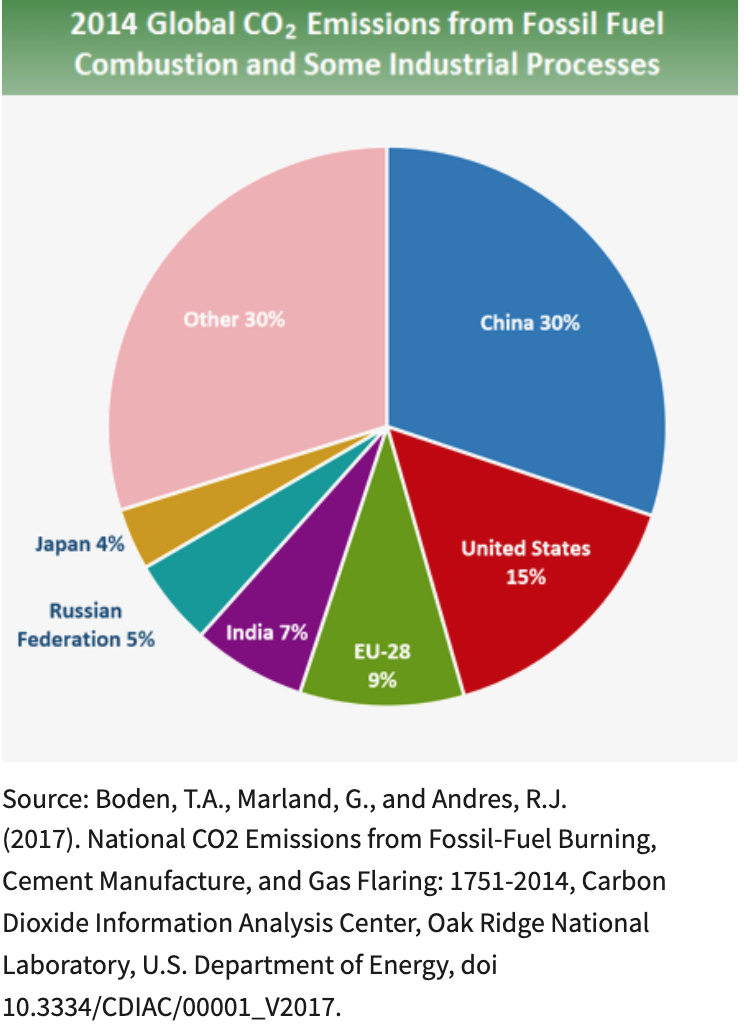
There’s a rumor going around that, after the fossil fuel industry that feeds our energy needs and results in 25% of all greenhouse gases emissions, the fashion industry was the second largest polluter in the world. This is a fact repeated in several documentaries about the fashion industry, and while, at least according to an EPA pie chart, it does not appear to be true, I believe I know what environmental category fast fashion hits the hardest: water.
pie chart courtesy EPA website
In fact, according to the Florida State University Sustainable Campus, “[t]he fashion industry is the second most water-intensive industry in the world, consuming around 79 billion cubic metres of water per year.” These numbers can seem unreal when there’s no metric against which to compare them so how about this one: to make one cotton t-shirt requires about 2,700 liters of water. And that’s just the water. There’s also the carbon footprint on the transportation costs, the pesticides used to grow the cotton (which ultimately runoff into streams and rivers), the dyes, the laundry detergent and disposal wastes, and the dangerous working conditions, to name a few others.
So what’s a fashion-forward consumer who also cares about the environment to do? A few things for starters, the three R’s — reduce, reuse and recycle. Buy good quality, sustainable brands that will last, and when you can’t wear that pink sweater one more time, donate it to charity. Buy second-hand when you can. Because of technology, there’s been a surge in purchasing reusable upscale clothing from the comfort of your couch. And don’t support fast fashion brands whose true tagline should be, here today, out of fashion tomorrow.
Luckily, not every fashion designer is of the fast sort. Today I’m talking with Resa McConaghy, quite possibly a poster child for slow fashion, a name that’s been given to the opposite of fast fashion, but is really a misnomer. A better name for Resa’s designs would be timeless fashion, just like my Aunt Marylou’s little black dresses.
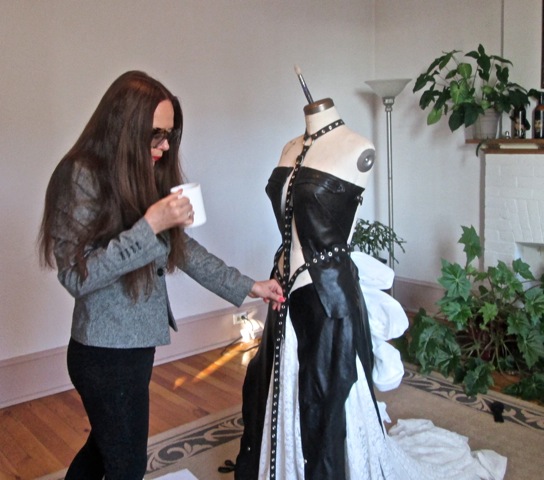
Resa, a fashion designer extraordinaire, possesses a flair for the dramatic as evidenced by the many costumes she’s created for movies and television, and to reiterate, she does not create fast fashion. Quite the opposite actually, Resa has an almost visceral need to reuse, repurpose, and upcycle, not only fabrics, but amazing items that, at first blush, would not be considered in the something to wear category. Resa’s environmentally-friendly approach is both fantastic for the environment and experimental, allowing her to create highly sought after one-of-a-kind designs which are near impossible to duplicate (take that, Zara!). Who says saving the planet can’t be a win-win?
I’ve been following Resa’s blog for some years now and am always amazed by her stunning work product, each design more extravagant and intriguing than the last. It’s not just her fabulous designs that set her apart from her peers, it’s her environmental ethic as well, something rarely spotted in the fashion world.
Like Carlo Petrini started the slow food movement to combat the fast food take over of the world, I hope Resa’s work starts a slow fashion movement to clothe the world in beautiful sustainable cloth and other reusable sundries.
So have a seat, read on, and tell me when you get to the end that you don’t want a one-of-a-kind Art Gown, by Resa McConaghy.
Your work goes back to 1988 and I counted 50 movies/TV series that have benefitted from your beautiful art gowns and that is not including those series with multiple episodes. That’s quite a resume and it seems to still be picking up steam. How did you get started in the business and what did you do to get to where you are today?
Thank you! Not all my film projects have gowns in them. There are all types of characters wearing all modes of clothing. I went to college and got an honours degree in Fashion Design and Technology. I then opened my own boutique, where I designed all the clothes. I had a small manufacturing set up in my basement. I had two employees. I made the patterns, and they helped me cut and sew the garments. I also did knitwear, as I had gotten another degree in Knit Design and Technology. I also worked in my boutique, doing sales. One day a producer for commercials came into my shop and looked around. She said they were having trouble getting men’s Arrow Shirts to fit Roman Style torso statues of men. Could I make the shirts fit these busts? I did great, and made more money in two days than I ever believed I could make. One job led to another. My boutique was a hand to mouth business. It was easy to give up my business, for the money I made styling for this area of the film industry. In my early years, I worked doing wardrobe for commercials, rock videos, shorts and anything I could get my hands on; whether I got paid or not. My career was a dream come true, even if I hadn’t dreamt it.
Prior to the pandemic, I had become fussy about the projects I would take on. Designing for film is wonderful, but I was always making someone else’s vision come true. As a creative person, I wanted to express a vision of my own. So, I started Art Gowns. I’d like to add that the film industry is a massive polluter! I was planning to do a show, with my Art Gowns on models, and with my art covering the walls, for sale. Then the virus walked into town. I began giving my all to my blog, drawing and making Art Gowns. My art skills have improved tremendously. I didn’t see the sense of risking getting Covid working on a film set. Also, Covid changed the industry, and the industry had already changed dramatically due to technology and corporate take overs. I still hope to do my show, one day. Will I do another film project? Yes, but it has to be a really great one.
How long does it take you to make a gown from concept to a finished piece? Do you make a pattern or freestyle it? Do you do the sewing yourself?
To make an Art Gown takes three to six months on average. Although I do some pattern drafting, the gowns are predominately done by draping on a Judy. Yes, I do the sewing myself. All of the Art Gowns are sewn by hand, my hands. No machines are involved, save the iron.
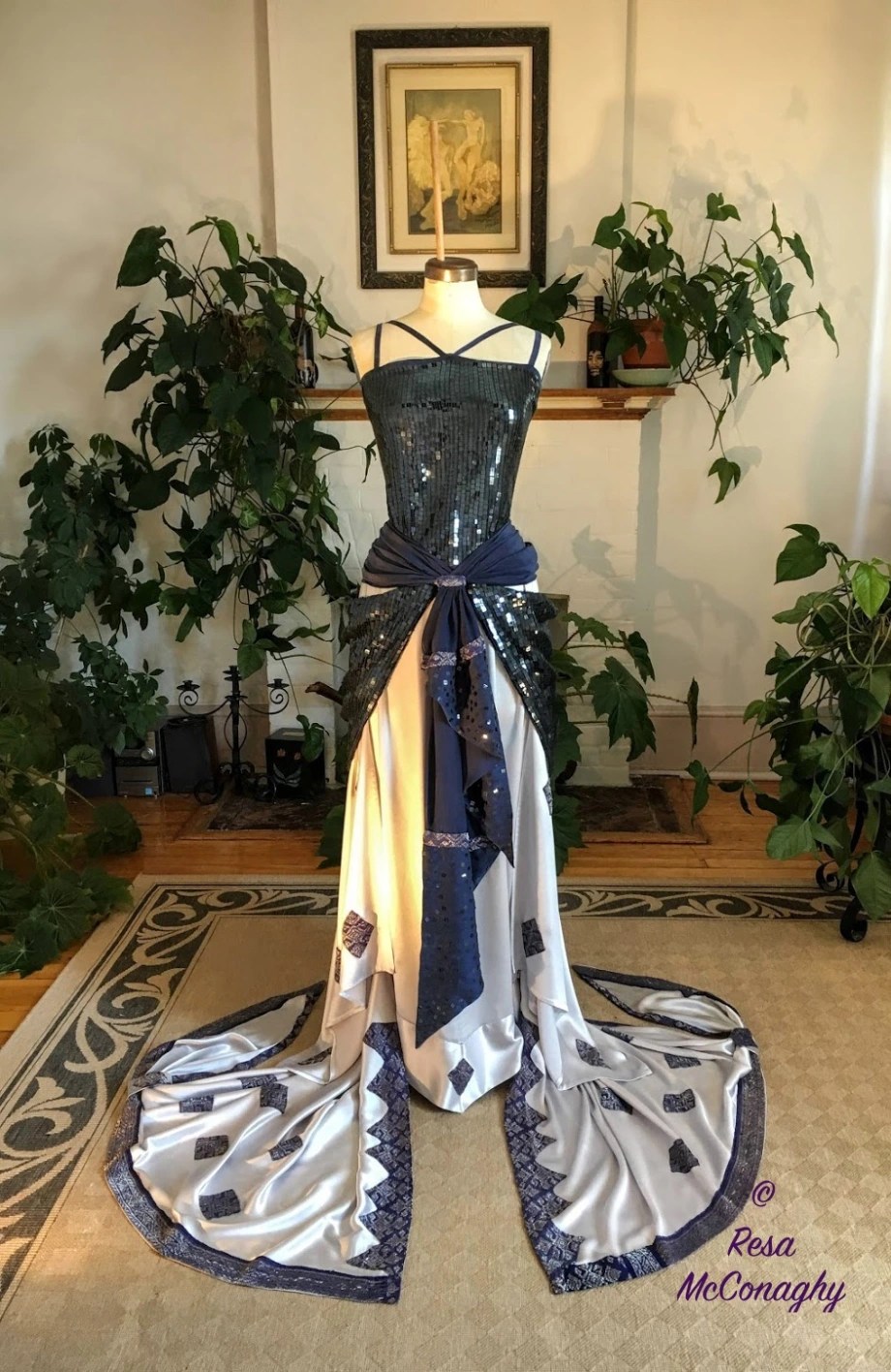
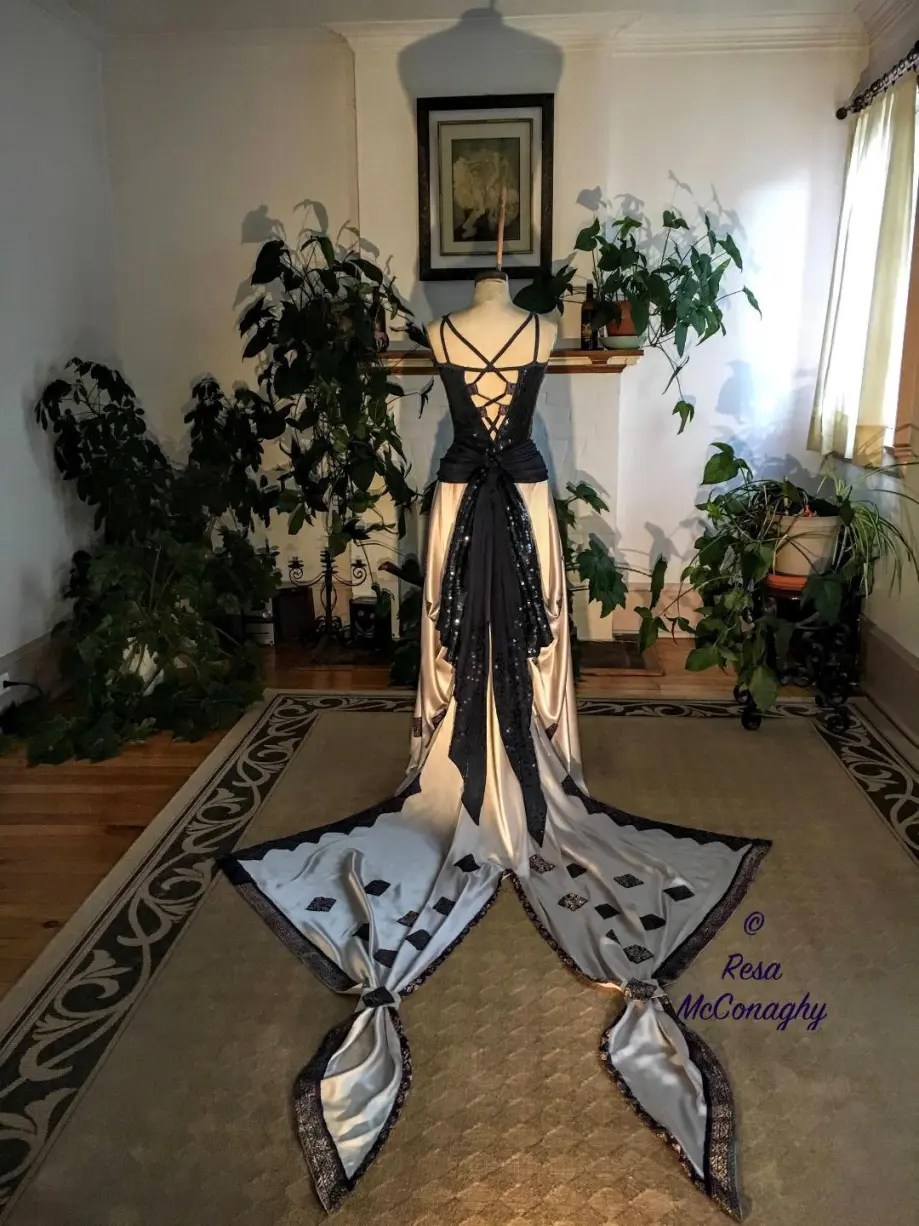
About the gown: CLEOPATRA CAPRICCIO is made from a piece of sequin material given to me by a friend. It was left over from a project he worked on. It sat for years in a box, waiting. I also used some silver curtain lining — 75 cents a yard at a liquidation sale — a piece of musty blue silk that had been in storage for 25 years and a 45-year old table runner that was on it’s last legs. You can read more about it here.
I note that you do a lot of period work and imagine it gets quite busy when you have a contract for several costumes at once? Do you have a full time staff helping you? Do you contract work out? Is it some combination of the two?
When I costume design a film, I design all of the characters, the look of the Extras… EVERYTHING! Yes, I have staff. Let’s use Our Fathers as an example. It starred: Christopher Plummer, Ted Danson, Daniel Baldwin, Brian Dennehy and Ellen Burstyn. I had two Assistant Designers (one for principals, one for Extras), a Floor Supervisor, a Truck person, a full sewing room with a cutter and about four stitchers, an Extras wrangler, and daily help as required for whatever department needed it. We farmed out some of the Priest’s and Bishop’s raiment. Christopher had a Personal Dresser. We had three semi trucks full of clothes. On the busiest of shooting days I would have a staff of 16 under me.
Sounds logistically overwhelming. No wonder it has to be a great project for you to consider jumping back into that beehive! Let’s talk about your period gowns, which I adore, especially the floor length models that are not something women in the 21st century generally wear. Do you prefer one period in history over another and if so, what’s your favorite?
I have no fave period. They are all interesting! Right now, I’m drawing 1920’s Art Gowns.
Have you ever made the same gown twice or is it once and done for each piece?
Once! The Art Gowns are all one-of-a-kind.
Do you sign your gowns into a hidden seam or some other secret compart-ment?
When we first spoke about doing an interview, you mentioned you hadn’t yet done a water gown — something I cannot wait to see, by the way. Where’s the inspiration come from for these gowns? Do you wait until someone hires you for a specific piece of work and then start thinking about it or is there something that inspires you? And when are you going to do that water gown?
So, the inspiration comes from all over the place. Most of the bloggers I follow are artists, writers, poets, photographers, nature lovers, etc. I get some ideas there. I find old decorator pillow cases, save wine corks, plastic mesh bags that produce comes in, collect old clothes made out of exciting fabrics – then take them apart, find old fabrics at jobbers that have been on the shelf for 20 years —I won’t spend more than $2 -$4 a yard. Last year an old friend found my blog. She sent me 40 pounds of old fabrics that had been gathering must from being stored in a garden shed for 20 years. No one hires me to make the Art Gowns. They are 100% mine. No one gets any say. I do however, dedicate them to people. Most are bloggers, but not all. Okay, the Water Gown. I actually thought of it when you commented on the last Art Gown I made. I’ve been to your blog and know you are all about clean water and green earth. I thought, I have a lot of old acetate lining in aqua greens and blues. That was a start to think on. Then I saw a pic of a small bubbling water fall, that a blogger had posted. I thought – those bubbles look like bubble wrap. What if I overlaid bubble wrap over the acetates? Of course I will not go out and buy new bubble wrap. We have lots in the basement from old shipments. I’ll try it out. If it works, I’ll ask friends not to throw away any bubble wrap they can’t use. Save it for me!
I have a similar creative process for writing. Everything is a source of inspiration. Was costume designing a childhood dream or did it evolve from something else? What other things are you passionate about?
No, I did not dream about being a costume designer, when I was young. I did however, make my own clothes. I am passionate about all the arts. Music means so much to me, I married a musician/composer/producer. I adore going for long walks and taking pics of street art.
What do you think about fast fashion, the sustainability of the fashion industry, and recreating synthetic fabrics in the lab?
Fast fashion sucks! It sucks at the earth and all of us. Used to be there was a mid-price range of clothing. It was decent quality and you didn’t throw it away after a month. Of course people had to do proper laundry (sweaters and certain things by hand wash), ironing and not give 2 hoots about a new trend every week. Fast fashion has robbed us of our own personal style. Now, there is just cheap garbage clothes, or clothing that is so expensive it’s heartbreaking. If I had $10,000.00 to spend on a dress, I wouldn’t. There’s a lot of need out there. Just think what a local food bank could do with ten grand! Marie Antionette may be dead, but the Marie Antionette spirit lives on. I did a bunch of research on synthetics. The pollution they create, on many levels, is sickening. They are virtually impossible to recycle. So far, whatever ideas have come up in this regard are of mostly of no value. They create more pollution than it’s worth. I had to stop doing the research. I was getting depressed. I believe I kept the re-search. That was just before the pandemic hit.
I agree. It’s mostly disheartening with very little cause for hope. Although there are a few designers, like yourself, who are touting sustainability. For example, Stella McCartney prides herself on not using leather, feathers or any other animal products. This year she launched Mylo, “the world!s first-ever garments made from vegan, lab-grown Mylo mushroom leather.” Basically, mycelium turned into clothing. First off, what do you think of the idea of using mushrooms to create clothing, and second, do you have any thoughts about how to address sustainability in the fashion business?
Sounds interesting! Good for Stella. I’ve been a vegetarian since I was a teenager. Mushrooms/fungus etc. maybe tasty in food, but they have almost no nutritional value. So, okay! A while back, certain health food stores were all puffed up that they were using bags made from corn. I said, there’s not enough corn. People and animals eat corn. It’s a staple. People are starving in many parts of the planet. Give them the corn. We can carry reusable totes. It’s all about balance. Sustainability in the fashion industry is a tough nut to crack at this point. The corporate profits are sky high. It’s up to people, each one of us individually and as a whole, to make it not profitable. They won’t change until they see a way to make bigger profits. This topic needs a blog of its own, with many weighing in, discussing, exposing the industry, gathering famous people to join the cause, exchanging our old clothes ….. and whatever else we can think of.
I agree. It’s going to be a process of reorientation toward sustainability. Speaking of, do you do any upcycling, recycling, or reusing of materials when you work?
All of the above!
If you in charge, how would you change the fashion industry? What is the most important thing, do you think? To regulate? To inspire? To lead? To shine a light?
Again, all of the above!
Do you think the fashion industry can do anything to combat climate change and if so, what?
Of course it can, but it needs to find the will. Human beings need to find the will, and that will drive industry. It blows me away that I see new plastic bottled water products introduced into the market place. (Oh, this one is flavoured!) It’s unconscionable but profitable. I saw cheap t-shirts made out of old plastic. That must feel disgusting on the body, possibly unhealthy since we also breathe through our skin, and at what cost to the environment did that plastic get turned into t-shirts. Beware of things that seem too good to be true!
Okay, after all that depressing talk, how about leave us with something inspiring, a bit of hope, perhaps?
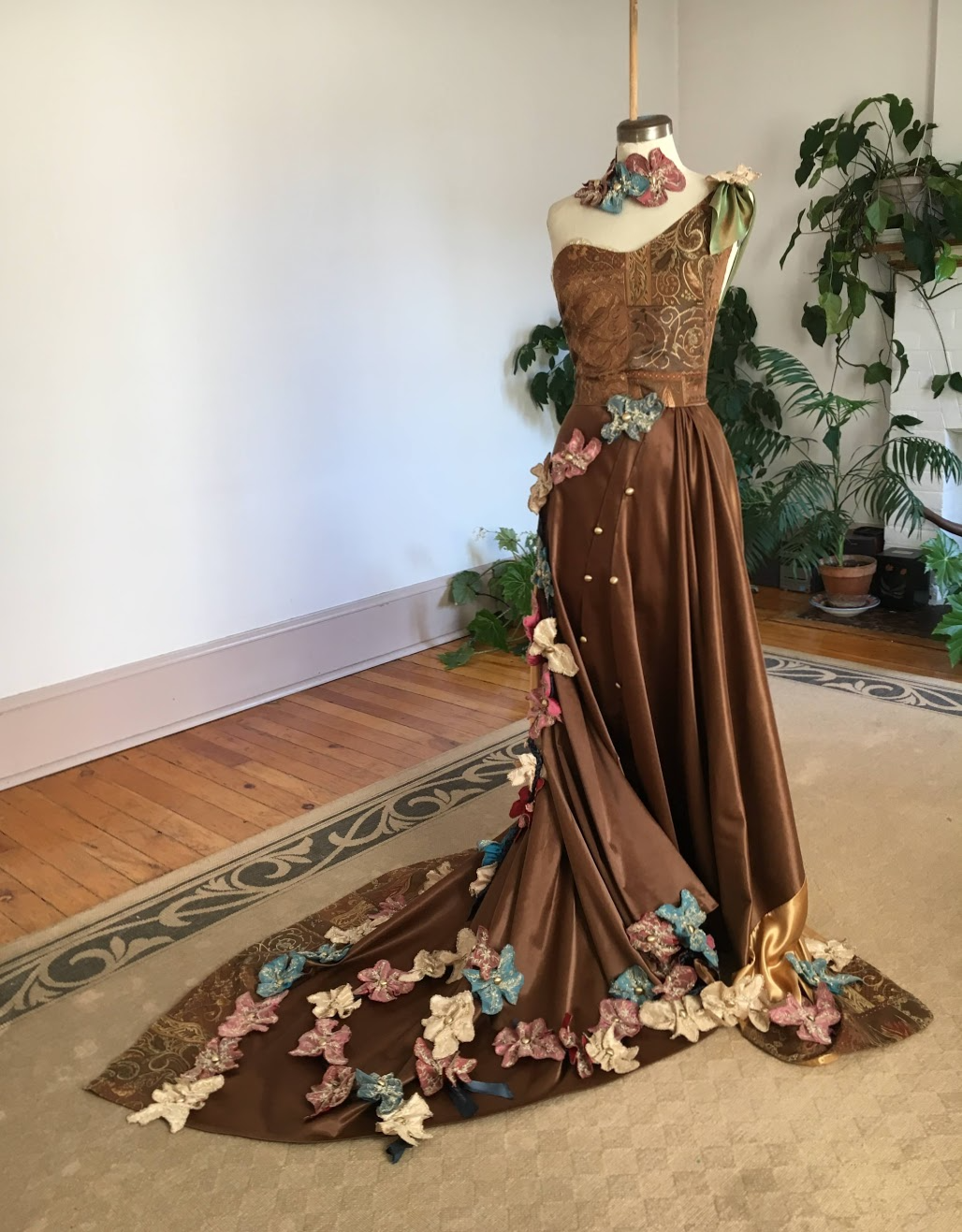
She is inspired from a large decorator pillow sham . . . probably 1980’s. I made the bodice out of it, and part of the tail. The skirt is out of a very odd fabric. It is almost like a shiny scuba material . . . possibly an upholstery fabric. The flowers are made from bits of colourful acetate lining scraps – overlaid with scraps of embroidered net left over from a wedding gown. The buttons have been sitting in their box for at least 10 years. The ties and sashes are from decent size leftovers, from projects from at least 20 years ago. You can read more about it here.
Resa, it’s been a pleasure speaking with you. Any last bits of advice to share?
I think we need to figure a way to move people back to natural fabrics. The challenge is washing and drying. Most people don’t know how to iron, and can’t afford to take them to the cleaners for pressing. Most cleaners do not offer JUST a pressing service anymore. Dry cleaning is a sin. My friends who did my dry cleaning on films for years shut it down and opened a wet cleaning service — no chemicals. It uses steam and natural cleansers. Unfortunately, it tripled the cost, but they have no competition. They went into great debt to buy the machines.
Also, most people don’t know anything about clothes with stretch. You get an instant fit. Manufacturers love this. No darts, less sewing, more profits, but synthetic (so at least partially made from fossil fuels). A designer needs to develop a line of clothes in natural fabrics that work conveniently for people. Otherwise, fast fashion will make a fast death for us all.
Resa, I wish you great success and hope your work influences the slow fashion movement for years to come.
If I told you one-eighth of the world’s inhabitants depend on wetlands for their livelihood you would probably say I’m crazy. They’re just swamps, right? Yes they are swamps, and yet, the Chesapeake Bay, the Louisiana Bayou, the Okefenokee Swamp, and the East Kolkata wetlands, to name a few, are not only some of the most hardworking environmental resources around with their fishing, crabbing, birding, aquaculture, ecotourism, and wastewater treatment abilities, but these ancient, massive primigenial havens of swampy, boggy, marshy, peaty, watery goodness are intrinsically cash cows.
But, and it’s a big but, these coastal and inland systems are under extreme pressure from both pollution and development, meaning 140,000 species of fish, about 55% of the fish population, are also at risk. Consider the problem of a failure of maintenance by the government in East Kolkata with this comment from wetland researcher, Dhruba Das Gupta:
“This year is the completion of two decades of Ramsar status for the East Kolkata Wetlands – and the story of these wetlands today is grim – with an acute capital crisis, a recalcitrant state and looming land sharks who are fooling the people regarding a liveable abode that just cannot materialise.“
Watch Dhruba’s 13-minute podcast for a primer on the East Kolkata wetlands; you’ll be amazed at what they do. The East Kolkata wetlands are a prime, and arguably best example of why wetland systems have tremendous importance on our planet, filtering 750 million liters of wastewater per day — what would cost $25 billion a year to do so mechanically — and also why we need to devote more time and money to the maintenance and preservation of these resources before they disappear.
Bald cypress, swamp tupelo, longleaf pine, bobcats, wild turkey and white-tailed deer and alligators galore inhabit this enormous drainage basin that straddles the divide between the Atlantic Ocean and the Gulf of Mexico draining from headwaters of the Suwannee (Gulf of Mexico) and the St. Marys (Atlantic Ocean) Rivers. Threatened and endangered species include the red cockaded woodpecker, wood storks and indigo snakes.
Yet the lure of lucrative minerals remained strong. In 2018, Twin Pines Minerals, LLC tried again but the company didn’t comprehend the size and strength of public opposition to its proposition in the form of 60,000 written comments.
Sadly, during the Trump administration, the Clean Water Act came under fire with the Navigable Waters Protection Rule which rolled back protections for wetlands generally outside of some stringent conditions like adjacency to waterways which meant the Army Corps of Engineers, the arm of the federal government tasked with issuing permits for wetlands development, would no longer make the decision, punting any permitting questions for the Okefenokee to Georgia regulators.
Enter the Georgia General Assembly and H.B. 1289.
Last week, this impossibly fertile and infinitely important landmark got a boost from state lawmakers in the form of H.B. 1289 — a bill introduced by five Republicans and one Democrat for those of us who think there is no bipartisanship left in the world — to protect the Okefenokee from mining.
A BILL to be entitled an Act to amend Part 3 of Article 2 of Chapter 4 of Title 12 of the Official Code of Georgia Annotated, relating to surface mining, so as to prohibit the director of the Environmental Protection Division of the Natural Resources Department from issuing, modifying, or renewing any permit or accepting any bond to conduct surface mining operations on the geological feature known as Trail Ridge between the St. Marys and Satilla Rivers for future permit applications and amendments; to provide for legislative findings; to provide for related matters; to repeal conflicting laws; and for other purposes.
The Okefenokee also makes bank. The U.S. Fish and Wildlife service estimates that for every dollar the state appropriates, the Okefenokee brings in $1.38 and that doesn’t count the myriad ways the swamp improves society and the environment.
Fingers crossed the bill becomes law and the Okefenokee is protected in perpetuity.
Just when I was starting to lose faith in humanity, something like this happens — politicians from opposite sides of the aisle coming together to save a world-class ecological site.
Today, February 14th, is Valentine’s Day, a universal day of love. But is there something more to Valentine’s Day than overpriced roses and chocolates? Let’s discuss.
The Greeks had seven different words for love which you can read more about here if you are interested. The cliff notes version goes like this: eros — romantic passionate love; philia — intimate, authentic friendship; ludus — playful, flirtatious love; storge — unconditional, familial love; philtautia — self-love; pragma — committed, companionate love; and agápe — empathetic, universal love.
I’d like to focus on the last one, agápe, something in very short supply at this time in our collective history. Agápe is the love of everything: God, nature, our dogs and cats, the people who drive us batshit crazy, the glorious sunrise, a beautiful snowfall, anything in the world and beyond. If we’re ever going to get back to balance on this planet, we all need a little more agápe in our lives, and perhaps a little less individualism, but that’s a topic for another blog post.
This post is about swamp love. So what if the Greeks didn’t have a word for swamp love? A lot of them lived on islands; it may have been a given.
While the regulatory definition of a wetland is complicated, the average person recognizes wetlands as wet and mucky places that hold standing water, i.e., not a housing developer’s favorite track of land. Therein lies the tension.
Wetlands are important for a variety of reasons: they control flooding, acting as a safe harbor for flood waters to recede slowly rather than rushing off downstream via stormwater drain conduits; they filter out toxins — such as heavy metals, oily contaminants and excess fertilizers and pesticides that would otherwise reach the rivers, streams and groundwater — by capturing them in their soils; and they provide a home to a variety of flora and fauna that thrive in watery places. Among other things, they’re beautiful.
Coastal wetlands act as a barrier between the mainland and the ocean, giving that vast body of water the space to expand and contract as storms and winds dictate, providing a much needed buffer in times of severe weather, while freshwater wetlands often act like the primordial soup of our humble beginnings for varieties of critters that need a sloshy place to get started. If you take anything away from the last paragraph it should be this: a healthy wetland ecosystem is great for the planet and all the humans, critters and vegetation that live on it.
Perhaps it is coincidence, perhaps not, but located in Southern Iraq and Iran lie the Mesopotamian Marshes, also known as the Iraqi Marshes, once the largest wetland ecosystem in the world — before they were systematically drained by Saddam Hussein — now reduced to 10% of their former glory. None of us knows what species of plants or animals were lost in the draining, but something tells me the world is a little poorer for it.
Of the 2,430 wetland sites designated worldwide, 41 of them are located in the U.S. February 2nd, the day the Ramsar treaty was signed, is globally recognized as World Wetlands Day.
Maybe it’s not time to drain the swamp at all, but to ensure it continues to thrive and grow.
Happy Swamp Love Day!
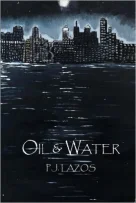
If you want to learn more about the Mesopotamian Marshes and the Marsh Arabs who live there, read her debut novel, Oil and Water, about oils spills and green technology, and yes, wetlands.
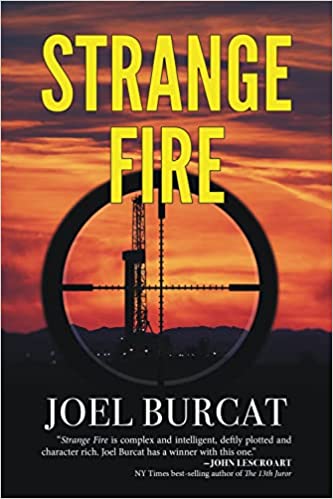
Well, my friend Joel Burcat is back at it, busy penning the next Great American Novel on a topic that I have to say is dear to my heart — Fracking!
First, a little synopsis:
Strange Fire, published February 1, 2022, is a gripping and romantically-charged environmental legal thriller about fracking and drilling for natural gas. Fracking for natural gas has turned deadly in Bradford County, Pa., and not only is the water contaminated, but people are dying. Round-the-clock operations conducted by Yukon Oil and Gas at their snake-ridden Campbell pad may have poisoned a residential well and now threatens a town’s water supply. Pennsylvania’s environmental agency, DEP, says the fracking of the Marcellus shale by Yukon did not cause the contamination. The neighbors have sued the agency and Mike Jacobs, a 29-year old environmental prosecutor with DEP, is back. He is ordered to represent the Commonwealth’s position. Because of the unique nature of the case, Mike finds himself on what he considers the “wrong” side. Mike suspects the neighbors are right and must get to the truth of the matter before he becomes a victim, too.
Mike must work alongside his law school nemesis, Darius Moore, now a rising star at DC’s prestigious Finkel & Updike, universally referred to as “FU.” Mike’s friendship with his geologist, Missy Shelton, grows into something much more than a professional relationship. The citizen activist, Teresa Bruno-Campbell becomes entirely too interested in Mike after he saves her son from a protest that becomes a riot. Roger Alden, Mike’s friend, mentor and boss, may not be able to save Mike from a serious lapse in judgment while Mike’s efforts to discern the truth put him in the intersecting crosshairs of this suspenseful and exhilarating legal mystery.
And then, a few questions:
Is Strange Fire based on a real story?
No. It is based on realistic scenarios. I took some information from EHB and court cases and incorporated that into the story.
Why did you write this book?
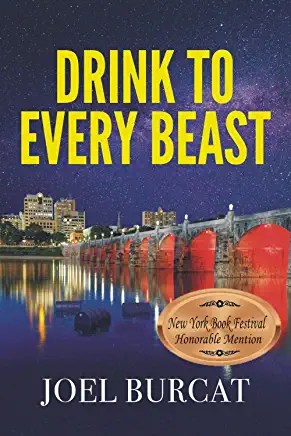
After writing books about hazardous waste dumping (Drink to Every Beast, 2019) and coal strip mining (Amid Rage, 2021), I wanted to write one on fracking. That, and climate change, are the two biggest issues impacting us today. Also, I wanted to wait until I was retired to write this book to avoid any potential conflicts of interest.
Everything in it is realistic. The drilling process described in the book is realistic. Real people fly into rages. Chemicals leak from drill sites. Government agencies make mistakes and have blinders on. I went to great pains to write a book that was factually accurate.
Are the characters based on real people?
No one in Strange Fire is based on a real person. Many of the characters have some DNA of people I have known or know of. Sometimes I will get a picture of an actor or actress off the internet and base the appearance of a character on the actor. When I wrote Amid Rage, I had a picture of Scarlett Johansen and another of Natalie Portman on my wall. They represented Miranda and Nicky. My wife wondered whether I was stalking them, but it was easier for me to look at the picture to describe a feature, than it was to make it up.
Are you Mike Jacobs?
No, however:
Mike is Jewish and so am I. Check
Mike is about my size and weight when I was in my 20s. Check
Mike went to Penn State and majored in Geography. Check
Mike went to Vermont Law School and became an environmental lawyer. Check
Mike went to work for DEP in Harrisburg. Check
Other than that, no.
Nice. Are any companies based on real companies?
Absolutely not. The companies are like the people in my stories. There may be a little corporate DNA in some of the companies and agencies in my stories. I made a point of NOT basing any companies in my stores after real companies. They are fictional.
Is the DEP in the book the real DEP which, if I recall, you worked for at one point in your legal career?
There is an agency of the Commonwealth of Pennsylvania government called the Department of Environmental Protection, DEP. I have taken great liberties and made up a fictional version of DEP. When James Patterson writes about the District of Columbia Police Department, Thomas Harris writes about the FBI, or Robert Crais writes about the LAPD, no one should assume that they are writing about the real DCPD, FBI, or LAPD. The same with my version of DEP. While I have loosely modeled my version after DEP, it is a fictional version.
Is the science and engineering in your story real?
I worked very hard to give as much accuracy as possible to the drilling, geology, and hydrogeology aspects of the book. Keep in mind, I worked with many industries in my 40+ year career, including the oil and gas industry and edited a book called The Law of Oil and Gas in Pa. In addition to my knowledge, I did a lot of research. Also, I consulted with experts when I thought I had everything right to make sure I really did have it correct. The experts suggested a number of changes to make things more accurate. Strange Fire is not a geology or drilling textbook, but you will learn something from this book. Of course, any errors are mine alone.
As an example, on page 2 there is a description of the production trees or “Christmas trees” as the industry calls them, located on a drilling pad. I went to great pains to get the technical details right. The NYT best-selling author, John Lescroart said of Strange Fire, “As a bonus, it’s also like a college course in fracking and the moral and technical issues surrounding fossil fuel extraction.” I won’t go quite that far, but he’s not incorrect.
How did you incorporate science, engineering, and drilling into the story?
That’s actually quite a challenge. Almost all of the technical details are quite boring if you are not an engineer or scientist. I did my best to sprinkle the technical stuff through the book, so no chapter is overly full of technical detail. Also, I tried to incorporate it through dialogue, in a way that was entertaining. A number of writers have been very successful at this: Michael Crichton wrote books dealing with medical issues that were scary and suspenseful as hell, then he wrote Jurassic Park. Tom Clancy’s first book contained detailed descriptions about nuclear submarines, radar, sonar, fighter jets, etc. and managed to sell 4.7 million copies and a major motion picture. He also launched a whole genre of thrillers called techno-thrillers. Other popular techno thriller authors include: Dan Brown, Preston and Child, Robert Ludlum, Jonathan Mayberry, and James Rollins.
What environmental fiction writers do you recommend?
Environmental Legal Thrillers (legal thrillers with a strong environmental element)
The Pelican Brief (John Grisham, 1992)
A Civil Action (Jonathan Harr, 1995)
Drink to Every Beast (Joel Burcat, 2019)
Amid Rage (Joel Burcat, 2021)
Cli-Fi (stories that focus on climate change)
State of Fear- (Michael Crichton, 2004)
Flight Behavior (Barbara Kingsolver, 2012)
Barkskins (Annie Proulx, 2016)
Is there going to be another Mike Jacobs book?
Probably. I’m working on one now. It is about a Flint, Michigan-type scenario where a public water supply is ruined by a factory wastewater discharge. It may not be my next book.
What are you working on now?
I’m working on a Cli-Fi book, tentatively called FIRE AND ICE.
Also, the following are done and in various stages of editing:
LITTLE BROTHER (a small town police department goes to war with the FBI)
LULLABIES AND OTHER LIES (young adult novel, about a group of teens who are the only survivors of a pandemic that has killed all of the adults of the world)
TEMPERATURE RISING (a young lobbyist gets caught up in a scheme to end all governmental support for climate change research)
Is it true you wrote Strange Fire after you became blind?
Yes. I have an eye disease called non-arteritic ischemic optic neuropathy and lost partial vision in my left eye in 2017. At that time, I lost enough vision to make me legally blind in that eye. On January 8, 2019, I lost partial vision in my right eye. I was fully legally blind by the end of February 2019. At about that time, I was inspired by watching a program on skiers with one leg, doing something abled people said they couldn’t do—downhill ski. I wanted to “prove” a blind person could do something people would think a blind person couldn’t do, so in March 2019, I started writing Strange Fire. I finished the first draft 7 weeks later.
Tell us a little more about yourself.
I went to Penn State and obtained a B.S. degree in geography and followed that up with a law degree from Vermont Law School. In 1980, I went to work for the Pa. Department of Environmental Resources and worked there for three years. I was in private practice until I retired. I’ve now published three novels: Drink to Every Beast (about dumping hazardous wastes, 2019), Amid Rage (about coal strip mining, 2021), and Strange Fire (about fracking, 2022). I have also been the co-editor of two major textbooks: Pa. Environmental Law and Practice and The Law of Oil and Gas in Pa.
I love classical music and classic rock (no relation). I follow Philadelphia sports teams but was 8 years old in 1964, so I’ve learned never to get my hopes up. My wife and I live in Harrisburg. We have two daughters, one in New York City and the other In South Philly. We have two grandchildren.
Best of luck with this new addition to the Burcat library of environmental novels, Joel. I look forward to reading it!
Sacred Commerce and the Twelve Virtues of the Merchant Priest
In November 2017, I posted a book review of Sacred Commerce, followed by a post on the Twelve Virtues of the Merchant Priest, honor, loyalty, nobility, virtue, grace, trust, courage, courtesy, gallantry, authority, service, and humility — traits that “automatically lift us to a higher octave of being.” I was going to do a post each month on the twelve virtues culminating at the end of 2018, but as it does, life got in the way, plus I got hung up a few times trying to find examples for what constituted selfless behavior in a society of me-first individuals. I’m down to the last two — service and humility. And I really can’t think of a better example of service than of our current President, Joe Biden.
Here is Service:
I’ve been a public servant for over 30 years so I know what it is to walk the tightrope of restrictions — Hatch Act; public scrutiny; gift giving; and more — all things most public servants take seriously. But nowhere is that job of public servant more difficult than as president of the United States where being the top executive is like walking the tightrope between the Twin Towers every day. Despite the Herculean effort it takes, President Biden has managed to do it and hold the country together in the process despite the great tug of war between the right and left.
After a single year in office, Biden has dealt with the coronavirus, the January 6th insurrection fallout; removal from Afghanistan; climate change resulting in huge storms and rogue tornadoes; the assault on voting rights; inflation; and a news media that throws shade for sport — and it’s not just Fox News although they are arguably the worst. Could his job be any harder? Despite issues that are magnitudes beyond the normal, Biden has taken them all on with a quiet determination in service to his country no matter what the media says.
Under Biden, unemployment is down, wages are growing, companies’ profit margins are up, and congress passed a $1.2 trillion infrastructure bill to repair our roads, bridges, water systems, and more. So why the shade? Are Americans just jaded and contrary?
There’s a legal maxim that possession is 9/10s of the law meaning that ownership is easier to maintain if you have possession of it. As President, Mr. Biden has ownership of the country’s ills, whether his fault or not, because people’s basic nature is to blame, and generally, blame falls to the person in charge. The fact that Biden can’t control the supply chain, for example, doesn’t matter: as President, it’s his job to fix it. It’s a little Pollyannaish to think this way, but it comes with the territory in a blame society, and Biden has accepted it without even flinching. Meanwhile, he has delivered the best economy since the Regan era with a growing GDP, along with the lowest unemployment, down from about 6% to 4% since taking office with the creation over 4 million jobs.
Yet haters gotta hate so they say nothing about these successes.
And do you know why? Because reality is 9/10s of perception and many people are living in an alternate reality controlled by the media. At least some of the media (hi Fox!) is only out to serve the media — not America, despite all it’s flag -waiving BS — and its own ratings because that translates to money in the pocket. Not truth, not fair and balanced reporting, not trying to save our democracy — these are all secondary to cold hard cash, so even when the news is not so bad the media spins it so it sounds bad. Why? Because bad sells.
Look, none of us gets to choose the suite of problems that come across our desks and the president of the United States knows this better than most. But wouldn’t it be nice if we Americans stopped complaining for ten minutes about all the things going wrong and instead, focused on the things going right? Maybe say “thank you” instead of “what have you done for me lately?” With a little gratitude, maybe we can all be friends again despite our political affiliations rather than watch the maelstrom of misery brought on by our insane culture of individualism. I’m all for individualism, but not at the expense of every other thing we’ve worked to build. Sometimes you have to take one for the team, and yes, that might mean wearing a mask on an airplane.
There is a Native American proverb that says: “no tree has branches so foolish as to fight among themselves.” We are all of the same tree so unless we want to start hacking off limbs to the detriment of all we need to figure out how to talk to each other civilly with an eye toward a common goal of a robust democracy rather than the hollow and singular ruling by a designated few. There is no way that only some of us win here. Either we all win or we all lose. Those are the only two choices despite what Fox News wants you to believe.
How can you be of service to your country? Start by doing something in service to someone else, maybe a hello to someone to whom you wouldn’t usually give the time of day. Follow it up with a smile, a nod, a thank you, perhaps, and see what happens next. The magic is in the moment and the moment is slipping away. Grab it before it does.
I had the pleasure of working with Luis González when he interned as a law clerk in our office last summer. Luis is currently a student at Vermont Law School, but as a San Diego, Cali resident, Luis has had a long history with water and some great ideas of how to conserve it while also making it more user friendly. As the world population grows and the demand for water along with it, we need to look closely at how to protect the source — both ground and surface water — from contaminants, wasteful practices, and other water abuses. And what a great idea to look at water through an EJ lens since that is where many of the water abuses are happening — in EJ communities. No matter how grim the future of water can look sometimes, when I read articles like Luis’, I know the future is in good hands. Read on and enjoy. pam lazos 1.23.22
p.s. a note on the text — because of my wordpress naiveté, I was unable to figure out how to add the footnotes to this article. If you are interested in the legal citations, please leave me a comment in the chat and I will send you the article as a pdf. Sorry for the inconvenience. pl
La Jolla, California
A. Introduction
Federal and state actions are necessary ravines that feed into the river of environmentally just solutions. However, municipal and county governments have an important role that they too can play. To be specific, California’s local governments can employ ordinances like: Cincinnati’s law creating an environmental justice review board, and Baltimore’s ban on crude oil terminals. These two strategies could serve local California governments to mitigate contamination, protect some of California’s most vulnerable communities, and work towards comprehensive and impactful environmental justice solutions.
B. Background
As California becomes more and more dependent on its groundwater, the state must take steps to make sure that its potable water does not become more contaminated. At the moment, about thirty percent of California’s water comes from groundwater, but it is projected that that number will go up—as a result of climate change’s negative effects on both the amount of snowpack in California’s mountains, and reduction in the stream of the Colorado River (the other major sources of California’s water). California depends even more on groundwater when it comes to drinking water; the California Department of Public Health (CDPH) estimates that about thirty million residents (out of California’s thirty-nine million) depend on groundwater for at least part of their drinking water supply. Although many groundwater basins are already contaminated with pollutants, further contamination can lead to costly treatment systems to make the water potable. It therefore makes far more sense to take preventive steps to safeguard California’s water—rather than after-the-fact clean-up and remediation.
Local governments in California are important in this conversation about contamination prevention because California municipalities and county governments play a strong role in land-use decisions and water planning. Alongside water boards, federal and state agencies, and tribal governments, local governments set the water policy, and manage everything from delivery, water treatment, irrigation, etc. Some argue that California’s decentralized and fragmented water management (and government style) may lead to policy gridlock and inaction when it comes to water policy. However, California’s federalist-style government should be seen as an opportunity—it allows for a diffusion of responsibility—the passing of possibly unpopular (but helpful and necessary) laws from different levels of government. Furthermore, it allows for more voter participation from residents, and increases efficiency since responsibilities are delegated into more digestible and simpler tasks (since there are more people and agencies involved). As a result, California is uniquely and favorably positioned to pass legislation protecting its ground and drinking water.
La Jolla, California
C. Applying Solutions
a. Cincinnati’s Environmental Justice Ordinance
The first law that California’s city and county governments should look at is Cincinnati’s 2009 ordinance that looked to build on existing zoning requirements. Essentially this review board would look into environmental justice factors and assess whether new development projects would be overly harmful towards environmental justice communities. The review board would do this in two ways. First, it would collect data on chemicals, pollutants, cancer risk, etc. existing in an area and any new risks from future developments and then publicize that information for community members to see. Second, the Cincinnati law required that officials provide “culturally competent outreach, including language of translation and explanation of scientific and technical issues, meetings… [and] longer comment periods.” These adages were meant to increase communication and transparency between city officials and concerned community members.
Although the Cincinnati law only passed into law but was never enforced (due to vehement opposition from local businesses and lobbyists), the law is still significant as a model for future legislation. Cities throughout California, whether or not their groundwater is currently contaminated or not, would benefit greatly from an added level of review like this. It builds off of existing zoning infrastructure and adds a layer of review that centers the interests of low-income communities and communities of color. This form of review would not be unheard of from what is already in place, especially with the increased use of discretionary review, which permits local officials to review development proposals and attach conditions to approval. Discretionary review allows planning commissions to review individual projects and cases even if the use is allowed under the existing zoning ordinance. Adding a condition that would require developers and officials to review based on cumulative impacts and environmental justice issues would not be a stretch of existing uses of discretionary review already taking place in California. For example, the California Environmental Quality Act already encourages public debate on environmental aspects of projects. And conditions that have been imposed by governments previously have required: “planting of a large number of trees, construction of affordable housing, the payment of a traffic mitigation fee.”
b.Baltimore’s Crude-Oil-Terminal Ban
The second law that local governments in California should consider is Baltimore’s ban on crude-oil terminals. With this law, the City of Baltimore repealed and rewrote its zoning ordinance, effectively banning new terminals and prohibiting the expansion of existing terminals. The 2018 ban was a response to the heavy impact of existing crude oil terminals to low-income communities and communities of color, along with heavy environmental justice activism from community members.
Oil pumps, refineries, and terminals can be found throughout residential communities in California. For example, California beachgoers may recall an easy-to-spot oil pump jack located next to single-family homes in Huntington Beach. Similarly to Baltimore, municipalities and county governments in California can use their power in zoning to limit the expansion of oil terminals. By definition, zoning ordinances are a set of regulations that restrict what landowners can do with their property. And California municipalities have a history of zoning-out businesses that they find unpopular or unwanted; for example, two thirds of California cities prohibit Marijuana dispensaries even though smoking marijuana recreationally and medicinally has been legal in the state since 2016. This strategy of zoning out unwanted businesses can also be seen with prohibitions to adult entertainment businesses, where although cities cannot create an outright ban on the industry (due to First Amendment concerns), cities are permitted to enforce reasonable zoning laws that direct unwanted industries away from residential communities. So, similarly to how California cities use zoning ordinances to prohibit or discourage marijuana dispensaries or adult entertainment businesses, they too can use their powers in zoning to assure that vulnerable communities are not located next to oil or gas extraction or refinement sites.
Lake Tahoe, Cali side
D. Conclusion
This is by no means an exhaustive list of ordinances that California municipalities and counties should look at—they are not even the most drastic laws to consider. However, these laws are relevant because they do not depart significantly from what is currently in place in California or cities across the country, and their application would not be disproportionately difficult. Local governments in California should look towards Baltimore’s 2018 ban on crude oil terminals and Cincinnati’s 2009 environmental justice ordinance as models for how to take impactful steps towards environmental justice solutions and safeguard California’s water supply.
Luis González
Luis González graduated from University of California, San Diego majoring in both Political Science and Ethnic Studies. They are currently a JD student at Vermont Law School where they continue to learn and write about environmental justice.
n. Person opposed to liberating hydrocarbons from their dark prison under the earth.
Humor aside, why not fracking? Is it activism gone awry or do we really have to take stock of what is coming and going in and out of the ground? After all, we need the energy, right? Wasn’t hydraulic fracturing sold to the American populace as a safer alternative to drilling for oil — like fossil fuel lite? Let’s drill down for a moment and consider what hydraulic fracturing is doing to the planet.
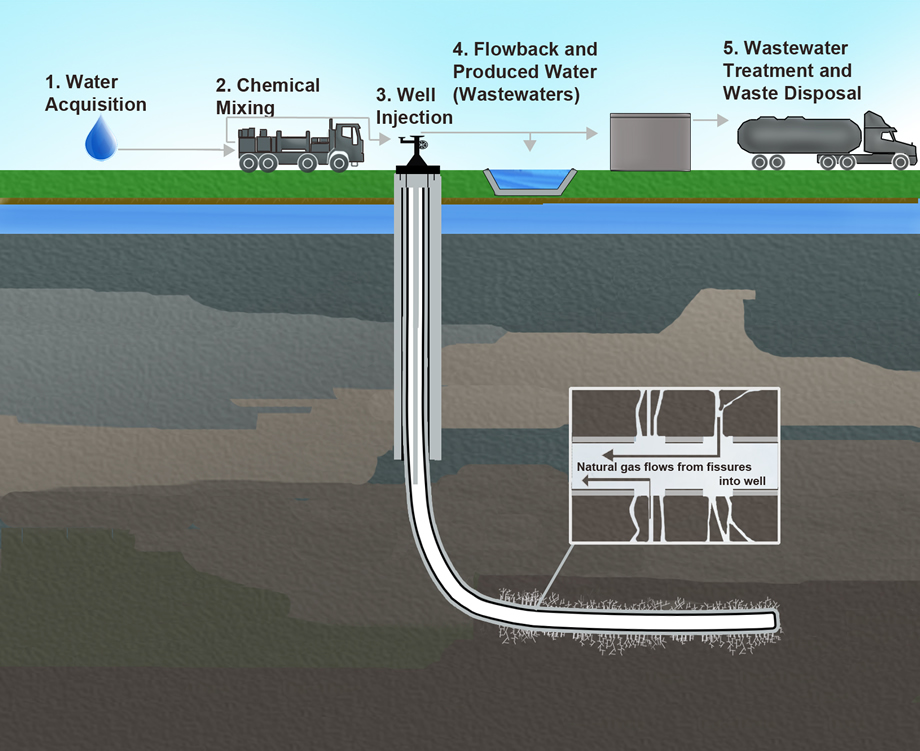
Graphic courtesy USEPA
Let’s start with an energy company drilling a hole. No big deal, right? We have tons of holes to get oil or water out of the ground, to build basements for houses, etc. But first the energy company builds a well pad sufficient to hold thousands of pounds of drilling machinery that will dig the hole. The well pad is typically placed near a stream because, if nothing else, fracking wells are thirsty business. The energy company drills down anywhere from 5,000 to 9,000 feet, the approximate depth of the Marcellus Shale, then inserts a pipe, encases the pipe in concrete — but only about 50′ to 100′ down — then pumps a combination of water, sand, and chemicals, dozens of likely hazardous, often unidentifiable substances — not because the company doesn’t know what they are but because they claim confidential business information on the mixture — at high pressure into the hole which extends about one to two miles underground into the Marcellus Shale. Then the energy company sets off a charge to fracture the bedrock, releasing the natural gas stored in the earth’s nooks and crannies, and the water pressure forces it back up the pipeline where it is captured, transported, and sold. Here’s a time-lapse video from Penn State if you want to see the process for yourself.
Before fracking, energy companies needed to rely on finding the larger stores of natural gas to do their extraction, but after fracking the earth knows no bounds because below the Marcellus Shale lies the Utica Shale which is anywhere from 5,000 to 11,000 feet and that means fracking will be with us for decades to come.
Why is this an issue? Because of the chemicals used in combination with water and sand to fracture the ground and force the gas to the surface. Because of the possibility of contaminating area groundwater. Because of the well pads themselves which are eyesores and ear-sores, often built in people’s backyards with pumps that run constantly and stadium lights that stay on 24/7.
I think I’ve set the stage sufficiently for the main event, an interview with Renard Cohen.
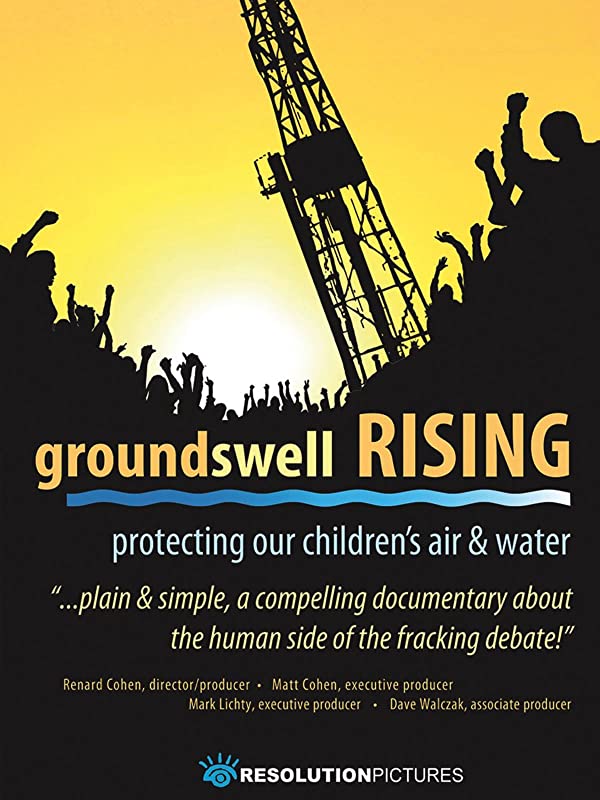
Renard is an Emmy Award winning television producer/director, composer, musician and filmmaker who has been involved in protecting our environment for many years as a past president of the nonprofit Pocono Environmental Coalition and Wild Life Society, cofounder and past president of the nonprofit Resolution Media Fund, who’s mission is to create media, education programs, music and films that support protecting our environment and our rights. He’s produced TV for PBS, National Geographic, Food Network, Fine Living Network, IBM, Teach For America, Court TV and more. His feature length documentary, Groundswell Rising, Protecting Our Children’s Air and Water was featured in 12 Film Festivals, won a Humanitarian Award, aired worldwide on Free Speech TV, RT and can be purchased on Amazon Prime TV.
Renard is the co-founder of artists4earth.com, an innovative website featuring an online art gallery of environmentally inspired art which can be downloaded for a donation to the Artists for Earth Project. The donations are then shared with partnering groups such as Food and Water Watchand Delaware River Keeper Network, turning art into support for the Earth. Renard, and partner Brian Van Korn wrote and recorded One Earth Song, and produced the video for the song.
And now, on to the questions:
You have a website, Artists4Earth, a community of artists who have donated their work to the cause of supporting different non-profits that work on behalf of the planet. First of all, great idea. Where did it come from, how’s it going, how long have you been at it, and do you feel your movement is successful? And if the answer to the last question is yes, how do you measure success?
When I directed and produced the documentary Groundswell Rising, Protecting our Children’s Air and Water, I met and filmed people who have been personally harmed by fracking and natural gas harvesting, people who have dedicated their lives to countering the abuses of the oil and gas industry, and those who would protect people from this harm. I wanted the film to give these people a greater voice than they would have talking to a group of people at a library or school. I am happy to say that we have accomplished this, and their words have been effective in warning other communities and educating legislators to take action to protect people facing the same harms.
I was hoping to find a way to help support some of the groups we worked with in making Groundswell Rising. Delaware River Keepers Network, a nonprofit that was able to keep the gas companies out of the Delaware River Basin (which supplies drinking water to millions of people) was one and Food and Water Watch another. I then learned of Green Amendments For the Generations, working to get green amendments in all the state constitutions and then the federal constitution. I wanted to find a way to help these groups who are on the front lines in the confronting the climate crisis in ways most of us are not.
For the last few years I had been providing music for an art competition involving environmentally inspired art. The Earth Speaks Art Competition features great art dedicated to heightening our awareness of the challenges we face from climate change and polluting technologies. When the art show was done, the art that was not sold would be brought back to the artist’s studios or closets and not seen again. I thought what a waste. I thought what if this art could be part of a web based art show, benefiting environmental groups. We could then honor the art and help the environment — soartists4earth.comwas born.
Did you know the artists you’ve recruited for the website before you started Artists4Earth? It looks like sales are limited to artists who work in visual arts. I get that because it’s something that is easily transferable, but have you thought about adding musicians, writers, filmmakers, and the like?
I had been working with a gifted artist/music producer, Brian Van Korn on a video we created for our composition and recording, One Earth Song when we began creating the initial website forArtists4earth.com.I reached out to some of the artists in our home Pocono region including Maciek Albrecht a Peabody and multi Emmy award-winning animator. Maciek was willing to allow digital copies of some of his drawings to be used for donations to download, and the funds to be given to our partnering nonprofits. With artists Maciek Albrecht, Lauri Henninger, John Yetter and Jack and Jill Swersie we had a start.
My production company Resolution Pictures, which also produced Groundswell Rising, edited the documentary, Art of the Fantastic. This film explores the fine artists who’s work brings to extraordinary life the world of science fiction, fantasy books, films, and designs for high level commercial art. When I shared the idea of artists4earth.com with Art of the Fantastic director Bill Niemeyer, he became on of our curators and invited top artists, Don Maitz, Volkan Baga and Donato Giancola to join us. Today with many accomplished artists, artists4earth.com is fulfilling its mission, turning art into support for the earth.
You made a film called Groundswell Rising that seeks to debunk many of the theories surrounding hydraulic fracturing, such as: it’s safe, easier on the planet than other forms of fossil fuel recovery, and that it’s integral to the U.S. becoming energy independent. Tell us about the movie, how it got started, and what prompted you to take on the task of letting the world know about the environmental ills caused by fracking?
Many years ago I was the president of The Pocono Environmental Coalition and Wildlife Society. When the current president invited me to attend a teach in at our local library on something called Fracking, I was intrigued. At this small gathering I learned that there was an industrial process that was being done literally on the doorsteps of residential homes, schools, nursing homes and sensitive areas that were in no way industrial. They showed a film by Dr. Theo Colborn on the dangers to people, nature, wildlife, air and water that are inherent in this toxic gas drilling technique. I was amazed that I had never heard of this and it was going on just miles from where I lived. There were two presenters, a woman from Pro Publica and a woman from The Community Legal Defense Fund. They spoke of how communities were organizing on local levels to keep this industrial intrusion out of their towns. I was inspired and decided that their story and others giving so much needed to be heard. I was determined to make a film about their work and mission. This film became Groundswell Rising.
One of the people in the movie has a T-shirt that says “fractivist”. Great shirt, BTW. You should sell them on your website. Were you an environmental activist from childhood or did it evolve over time? Was there a the precipitating factor or did you just come into this world wanting to do good for the environment?
I turned 13 in 1963 and along with the Beatles, opposition to the Vietnam War, the need to feed places like Biafra and Bangladesh, the civil rights movement, and tragic assassinations, my consciousness was raised.I began playing piano at age 4 and guitar at 13. Inspired by Dylan, Phil Ochs, and the Beatles I began writing songs at 13. My parents were founding members of one of the foremost theater groups on Long Island NY, Lantern Theater. So I began acting at around 11 years old. I was treated like an adult by the other cast members and enjoyed the collaborative effort of doing theater. My view of the world was shaped by Ipsen, Tennessee Williams and Arthur Miller. I played Peter in The Diary of Ann Frank, and my Mother, Felice Cohen played my mother. It was a great education.
I was a freshman at Emerson College in Boston in 1969 when Kent State happened and the boycott began. I helped alert the students about the strike by making and distributing a flyer, ( I had a job at the school print shop) and organizing students to go into the offices and call all of the commuter students. I was a rebel. My activism ignited.
I have a theory, I believe the activism of the 60s was precipitated by the TV shows of the 50s. As kids we were told on the shows like Captain Kangaroo, Kukla Fran and Ollie, Mickey Mouse Club and Howdy Doody, ( I was on the Howdy Doody show in the Peanut Gallery and interviewed at 7) that the police were our friends, and America stood for truth, honesty and doing the right thing. When we saw Selma, the killing of King, the Kennedys and Malcom X, and the revelations of the Pentagon Papers, we felt betrayed and wanted to drop out and protest. A lot of us are still there.
When we began to understand that global warming was happening, with films like Inconvenient Truth and it became clear that our leaders and heads of industry were denying it, we made the decision to do what we could to tip the balance to sanity and protection for our children and grandchildren’s futures. I say we but I understand that I made these decisions for myself. I began by writing songs that spoke of the things I was concerned with and then given the opportunity, I decided to use my knowledge as a filmmaker to create Groundswell Rising (Resolution Pictures, founded by my brother Matt Cohen and myself makes shows for The Food Net, PBS, IBM, National Geographic, etc., and has won an Emmy for a 5-part PBS miniseries, Seasoned With Spirit, A Native Cooks Journey). After the film came out, I introduced it at many screenings, and opened the show by singing the theme song live. I am still up for doing this when asked. The film was on Free Speech TV, Russia Today, 12 film fests, won a Humanitarian Award and now is on Amazon Prime. It has been used to help get bans of fracking through in Florida, Maryland, New York, Scotland and other places.
photo courtesy USGS
How much research did you do before you started making Groundswell Rising? Did you know the people you showcased in the movie — for example, Maya Van Rossum — before you started the movie or did your work in the environmental movement result in Groundswell Rising as a collaboration? BTW, Van Rossum is an adjunct professor at Temple Law, my alma mater, although we missed each other by a few years.
Before I went to a library teach-in about Fracking, I didn’t have any idea what it was. This opened my eyes and after I decided to do the film, I started going to local events to shoot and learn more. I went to an Earth Day event at Muhlenberg College and learned about rural country roads being turned into clogged industrial highways by fracking. I heard they were spreading dangerous frack water on roads as deicer, and heard a rep from a business group proclaim that fracking was our best financial opportunity. Some of this made it into the film. We then shot a program at North Hampton Community College with Dr. Tony Ingraffea, a former oil company engineer who was spreading the word on the dangers of fracking. It was there that I leaned that by the industry’s own admission 3-5% of all wells leak methane from their first days, then leak more as time goes on. And there are thousands of wells, leaking and burning methane off into the environment.
The more I learned the more determined I was that this story, which most of us were unaware of, had to get out. I then stared meeting people who were dedicating their lives to protecting us from fracking and industrial pollution, including Sandra Steingraber, a victim of industrial pollution which resulted in her contracting bladder cancer at the age of 20. Now a scientist, she was leading the charge against the effects of frackng, especially in babies and children. Sandra became an important part of Groundswell Rising and I was very glad to help get her message out to more people.
I then met some of the leading activists who were working to help communities keep fracking out of their towns. The habit of the Oil and Gas Companies was to sneak into a town before anyone knew what was happening. The individuals I met and included in the film were alerting people and organizing them to keep this away from their kids and literally, their doorsteps. I was able to show some success so the film became not only about the dangers but also about what we can do to protect ourselves. As this movement grew it became, and still is, a groundswell rising.
I listened to a Smartless podcast the other day with Admiral Vivek Murthy, the Surgeon General of the U.S. and he said that if the people in power now would be around to see the effects of climate change, there would probably be more political will. What is your view of the world and its leaders at this particular time in history and are you hopeful or do you feel we may actually be running out of road?
I think because we trusted those in power to watch out for us, we let them make decisions that did not have our best interests as their top priority. We should have not been surprised, we knew that in the Bush 2 Administration, Cheney and the Bush Family came from the oil and gas industry. We learned about the Halliburton Loophole, (Cheney’s former company) letting the oil industry be exempt from the clean air act, the clean water act, and others put in place to protect us. We learned later that Exxon had researched climate change and determined that we would be responsible for it and that it would be harmful, but then denied it in pronouncements. We also found out that the oil industry hired the same PR firm the tobacco industry used to deny a cancer and smoking connection, to convince the public that there was no climate emergency and humans had nothing to do with climate changes though their own research was to the contrary.
I am cautiously optimistic that we can pull together and mitigate our climate crisis in time to cut short the worst outcomes. There is always the possibility that new technologies and unified action can turn the tide. It does worry me to see that the reaction of many areas is to prepare for the worst outcomes like building dikes and moving to higher ground instead of working to fix the problem. I don’t know how it will turn out, but we must do what we can, for our children and grandchildren. I say this as a father of five and, as of now, a grandfather of two with a new grandchild on the way.
the artist on the water
In the constant quest that each one of us has to become the best version of ourselves, how has your history — childhood, adolescence, and adulthood — hampered or spurred you on to becoming the version, and what is it that brought you to the environmental movement with such gusto?
My first exposure to the problem of environmental degradation was seeing the pictures of the dark clouds of smog that hung over cities like LA and NY. It was hard to dismiss. Then I heard about acid rain, the hole in the ozone layer, and the burning of the rain forests. In the case of smog, I believe that progress has been made and cities are somewhat less polluted, but until approximately 30 years ago, most of us were unaware of the real threat of the climate crisis. We saw the Native American with a tear in his eye talking about littering and garbage, but who knew that we were facing an existential threat.
There is an old Buddhist saying: when you know, you can’t not know, so the more I learned about what science was saying about our part in creating a climate calamity, the more I wanted to use whatever talents and abilities I had to help educate the public on what we can do to meet the challenge. And as I realized that most people didn’t really have a clue about what we face and our responsibility in it, it became clear that films like Groundswell Rising could expose the problems and talk about how we can at least protect our communities.
Talk about the unregulated oil and gas industry. How did it avoid the usual regulations?
From the time oil was discovered in Pennsylvania and became our dominant form of fuel, a decision was made about what kind of world we would have. Not everyone was consulted and as usual in our society, those who stood to make lots of money had the power to institute fossil fuel for almost all of our energy needs. Certainly the adopting of the combustion engine and powering private small individual-use cars became the key to our growth and process. To question the wisdom of this track was seen as un-American and anti progress. Moguls of the oil and gas industry had direct influence on and eventually became our government leaders. And now we know that the oil and gas companies had their own in-house studies that confirmed that we were causing real environmental harm, and they decided to squash their own findings and deny it. So we are way behind the curve in being able to respond in time and address the problems. But what can we do but try!
Groundswell Risingtalks about some statistics, like the failure rate of new wells being one out of 20, or approximately 5%; how 30% of wells will leak after a decade (and we have no idea how many after a century); and how the energy companies were only required to do a 250’ setback from residential properties, resulting in people having fracking wells adjacent to their backyards, a severe detriment — like in the case of the homeowners in Dimock, PA — to the home’s sanctity and the owner’s peace of mind. The movie also talked about the fact that the fracking companies know they are not capturing all emission even though they have represented to the homeowners that their processes are safe. What is the fix, do you think, when the company misrepresents the health risks associated with these gas wells?
There was a time not long ago when knowledgeable people were concerned about Peak Oil. We thought oil was running out. There was a real push to start creating new sources of energy. Hydrogen-powered cars with only water as the exhaust were being researched by companies like British Petroleum. There was new interest in renewables.
Then a scientist in Pennsylvania discovered the Marcellus Shale deposits and a technique that used great amounts of fresh water, a cocktail of potentially harmful chemicals, along with earthshaking explosions to bring the shale oil and gas to the surface. That is fracking. Once the gas is at the surface, there are many problems with storage, leaking methane, transportation, water contamination, and more.Before the real environmental downside of this technology was publicly known, laws giving the industry a pass on important water, air and soil protections were instituted.Before long, with fracked gas and new oil deposits found in the US, we were awash in oil and gas. We went from being an oil importer to being an oil and gas exporter, making it even harder for us to want to move past fossil fuels, into clean renewable technologies. But if we want to or not, science tells us that we must make these changes for our children and grandchildren to survive.
Where are the adults? Where are the leaders that can give us real choices and the consequences, good and bad, of those choices? We are at a crossroads.
I have heard many different numbers on how much more of a green house gas driver methane is. I guess it depends on what method you use to measure. But what they all say is that methane is many times worse for the environment than carbon or CO2. Fracked or “Natural” gas is methane. And it gets released into our environment by the industry in many ways, from harvest to transport to use.The truth is, we don’t need to rely on methane or any fossil fuel to power the earth. Studies show that we can power the earth with renewables. It requires the will and support of the people and the real desire to meet the challenges before it is too late (and we are getting close).
In the movie you talk about a Green Amendment which is an idea started by Maya van Rossum who has also written a book about it. What is the Green Amendment and how did you begin working with Professor van Rossum.
The oil and gas industries had their sights set on fracking in the Delaware River Basin. This basin provides the drinking water for millions of people including New York, Delaware, Pennsylvannia, Maryland, New Jersey and Virginia. The responsibility to keep this water safe falls on the Delaware River Basin Commission. When it became known that the Commission we set to allow the Oil Companies to come in and Frack the Basin, Delaware River Keepers Network, lead by Maya Van Rossum, sprang into action and brought protestors, environmentalists and educators to the Delaware River Basin Commission (DRBC) meeting and demanded that no permission should be given until much more extensive research was done on the dangers instead of just relying on the assurances the industry was supplying. It worked and the Commission eventually banned fracking from the Basin. Maya and her actions with the Delaware River Keeper became an important part of Groundswell Rising. Artists4earth and its partnering organizations continues to work with Maya and her new group, Green Amendments For The Generations, working to establish Green Amendments to the constitutions of all states and the federal constitution. With these laws in place, environmental protections will be much stronger and harder to sweep aside with the Presidential Pen.
Let’s talk about renewables which the movie touts as being sufficient to power our entire country. If this is the case, what is stopping us from not walking, but running in that direction, meaning, why aren’t we doing more and how do you suggest we start?
In 2013, Scientific American asked two scientists to do a study on the feasibility of powering the world solely with renewable energy. Using just technologies available then they determined that this could be done — without huge upheaval and disruption of life — and laid out a plan to do so. I traveled to California to interview one of the scientists, Mark Jacobson, for Groundswell Rising. In the film, Mark says, based on his research, there is no technical reason that we can’t power the world with renewables, it is just the will to do it and the social pressure needed to make these changes happen. Mark now has The Solutions Project, which is helping cities, states and countries make the transition to clean renewable energy. He is working with Mark Ruffalo (also in Groundswell Rising) and Leonardo DiCaprio on the project.
In Catching the Sun, a documentary by filmmaker Shalini Kantayya, she has a segment on Van Jones, formerly Obama’s green jobs czar, and founder of the renewable energy training organization Green for All, an organization that trained people, generally in underserved communities, to install solar panels, giving them access to a living wage and a sense of community. In addition, I just read an article in Brookings Institute that we don’t just need the money from Build Back Better to go green, we also need people who will be able to implement the changes which means we need more money going to states and localities for training/retraining of these new technologies. How do we make this happen? Do we need a couple thousand Vance Jones to take up this crucial work and if so, how do we find them?
It is very gratifying to see more and more young people getting involved with responding to the climate crisis. I am heartened by the divestment movement on many college campuses, which demands that the school’s investments move away from fossil fuels and harmful practices and technologies. It was only after countries divested from South Africa that apartheid began to loose support and ended.
When I am faced with the question of whether we as a society can really change I think of how we moved past smoking. I remember when every office, bus, club, airplane, taxi, movie, train, sports arena, theater and government building was filled with smoke. When the question, “Do you mind if I smoke?” was met with a yes, you were looked at like a selfish tree-hugging lout.Finally, after years of the cigarette companies advertising, proclaiming that there was no connection between smoking and cancer, we woke up and said this needs to stop. And it did. Good for us!
The same cohesion and common sense needs to unify us now to slow down and hopefully reverse the effects our society is having on our climate, our health, our co-habitant plants and animals, and our interaction with each other. If anything I do can move us closer to healthier outcomes, I will have lived a good life.
I have one more question: do you think music can save the world and if so, why?
Throughout my life I have dedicated what talents I have to positive change and social causes. I believe that music is a special gift and has the ability to heal and inspire. Being a conduit for that energy is very fulfilling and my desire is to help mankind evolve to more sensitivity, fairness and wisdom.
If my music can help with that, I will be grateful.
Renard, thanks so much for taking the time to tell us about your work. It’s been terrific and enlightening. Wishing you all the best in realizing your vision for the kind of environment that supports us all. I’ll be looking out for your next project.
Interested in contacting Renard? You can find him at Artists4earth.com, a group of world class artists, including Emmy winners, Hugo Award winners, Earth Speaks winners and many other great artists from all parts of the world. Their artists submit work that will be used as thank you gifts for donations to artists4earth’s nonprofit environmental partners. Artists4earth partners include: Food and Water Watch, Delaware River Keepers, Move Past Plastic, and Green Amendments for the Generations . The 501(c)(3) Resolution Media Fund collects and distributes the funds, turning art into support for the earth.