
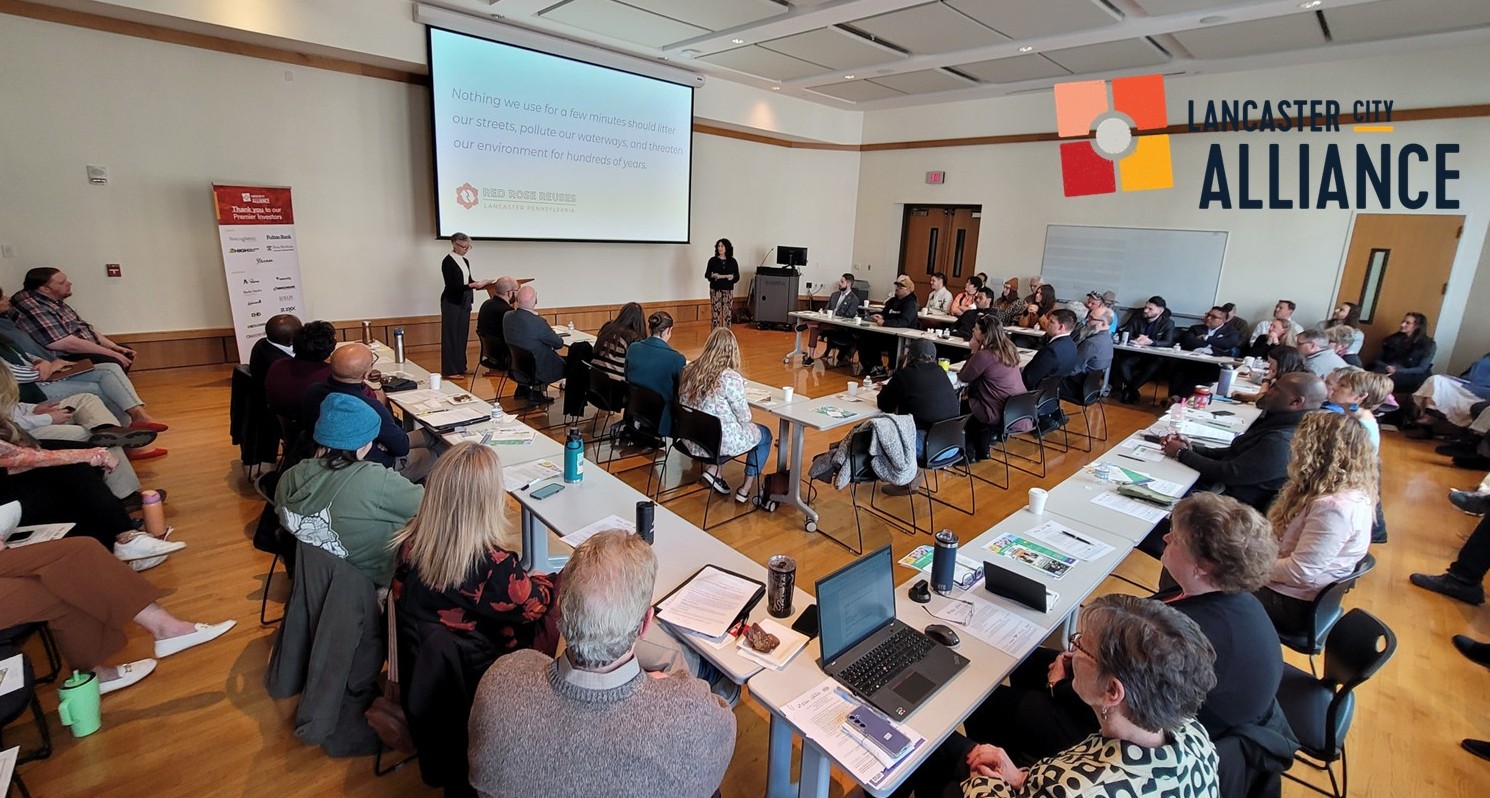
Photo credit, Karl Gibbons, Third-Eye Management
In April, Melissa Snavely and I, co-directors of Red Rose Reuses, had the pleasure of presenting a talk on reducing single-use plastics. Red Rose Reuses originated under the umbrella of College Park Climate Action Neighborhood (CAN), an affiliate of RegenAll. RegenAll is a local non-profit working towards carbon neutrality across business, agricultural, and neighborhood networks.
CAN borders F&M and Buchanan Park in Lancaster, PA, and just completed its first year of community climate action. One of our first initiatives was the Plastics Awareness Project – part personal audit, part educational, and part call for direct action. But mostly, it was a thorough look at the proliferation of plastics in our everyday lives, not just in our homes and the environment, but also at the growing evidence of microplastics in our bodies. It was through that program that a small but determined group decided to advocate for the reduction of single-use plastics in the City of Lancaster. Hence, Red Rose Reuses was born.
We have lived on planet Earth for a long time, but in the centuries since the Industrial Revolution, we began living out of balance, resulting in oversized problems that we never took the time to solve upfront. Nuclear and hazardous waste, human waste, and now plastic waste all contribute to our waste issues. Some have no viable, permanent solutions, like nuclear waste; some add chemicals to the water as part of the solution, like human waste, and some, like hazardous waste, can be contained in a facility, but eventually, those containment sites will need to be rethought since they are only stopgap measures.
And now we have plastic, which doesn’t break down or biodegrade except into smaller and smaller pieces. Sadly, the more plastic we make, the more we have to clean up, and since we don’t yet have a viable way to deal with plastic pollution, rather than amp up production, we should be looking for ways to reduce, reuse, and recycle.
Here are a few facts:
- 9.1 billion tons of plastic have been produced since its introduction in the 1950s.
- Virtually every piece of plastic ever made still exists in some shape or form (except the small amount that has been incinerated).
- 91% of plastic waste isn’t recycled, and plastic doesn’t biodegrade, which means it could exist for hundreds or even thousands of years.
- One million plastic bottles are purchased every minute around the world.
- 33 billion pounds of plastic enter the ocean every year.
- Marine animals eat plastic, thinking it’s food, and it causes them to starve because they can’t digest it.
- By 2050, there will be more plastic in the ocean than fish.
- On average, people ingest 5 grams of plastic (about the weight of a credit card) every week, or approximately 100,000 pieces of microplastics each year.
- The result? Microplastics have been found in our lungs, livers, spleens, and kidneys, sometimes with fatal effects.
Let’s talk about the costs:
- It takes 12 million barrels of oil to manufacture the 30 billion plastic bags consumed in the US annually.
- About 8 percent of the world’s total oil production goes to making plastic. More importantly, production is expected to triple by 2050.
- A single-use plastic bag costs between $.05 and $.07 and has a useful life of about 12 minutes.
- A single-use ketchup packet costs between $0.03 and $0.25, depending on your buying capacity; an estimated 855 billion condiment packets are discarded yearly globally!
- Besides pollution, there are many other unintended consequences of plastic waste, such as health care costs. The National Institutes of Health says we spend about $250 billion/yr in health care costs, attributable to the chemicals used to make plastics, which is not surprising given that microplastics are consistently being discovered in our brains, blood, and bodies in general.
There are a great many benefits to be derived from reducing our reliance on plastics and the petroleum products that create them (and which I will save for the next post).
For now, I’d like to introduce you to Karl Gibbons, a Business Growth Architect, and one of the most intriguing and knowledgeable people I’ve ever had the pleasure to meet. Karl has some heady ideas about changing human behavior and offered to write the following piece. I hope you will read it and chime in with your own thoughts on this topic, which, from an environmental and health standpoint, is one of the most pressing issues of our time.

Behavioral Economics & the Packaging Problem: How to Nudge the World Toward Sustainability
Behavioral Economics is the study of how people actually make decisions — not how we think they should. It blends psychology with economics to understand the biases, triggers, and shortcuts that guide human behavior. And when it comes to saving the planet, those insights aren’t just useful — they’re essential.
If we want people to choose recyclable or biodegradable packaging, we have to accept a simple truth: facts alone don’t drive action. Logic informs, but emotion moves. The good news? We can use behavioral nudges — small, strategic shifts in the environment or incentives — to encourage more sustainable choices.
Take ketchup packets, for example.
Globally, we throw away an estimated 855 billion single-use condiment packets every year. These tiny sachets — mostly made of plastic and aluminum — are nearly impossible to recycle and almost always end up in landfills.
So, how do we change the behavior?
Simple: we attach a cost to the unsustainable choice and remove the friction from the better one.
Imagine a fast-food restaurant that charges 50 cents per ketchup or mustard sachet – a WasteRate, but offers manual pump dispensers at no cost and issues PlanetPoints. That’s not just an eco-friendly option — it’s a behavioral nudge rooted in loss aversion (people hate losing money) and convenience. Suddenly, the path of least resistance aligns with the planet’s interests.
This is how we use Behavioral Economics to reshape habits—by creating either pain (a penalty or cost for wasteful choices) or pleasure (a reward or savings for sustainable ones).
Let’s apply this to supermarkets. What if clear plastic containers were taxed a WasteRate at checkout — but products in biodegradable or recyclable packaging came with a discount or loyalty PlanetPoints bonus? That small price signal would subtly shift consumer behavior over time, nudging people to favor packaging that doesn’t live forever in a landfill.
And it’s not just about consumers. Packaging manufacturers could be offered tiered incentives based on the recyclability and sustainability of their materials. EcoCredits (tax credits) for producing compostable containers. EcoTax penalties for generating hard-to-recycle waste. That’s how you drive change not only at the point of sale—but at the source.
The science is clear: people don’t always do what’s best for the environment — but they will respond to clear signals, smart incentives, and well-designed choices. Behavioral Economics gives us the blueprint to redesign those decisions.
Saving the planet won’t come from guilt trips or greenwashing. It’ll come from creating systems that make the right choice the easy choice.
About the Author
Karl M. Gibbons is a Business Growth Architect and the Founder of Third Eye Management & Associates (TEMA)—a strategic partner for purpose-driven entrepreneurs, brands, and organizations looking to grow smarter, scale faster, and build businesses that truly matter. With over 40 years of experience across multiple sectors, Karl blends Behavioral Economics with real-world strategy to help leaders create brands that are not only successful but uncopyable in their mission and marketplace.
📍 www.ThirdEyeManagement.com
📧 karl@thirdeyemanagement.com
🔗 LinkedIn: https://www.linkedin.com/in/karlgibbons
📞 (239) 961 0927
Regards
Karl
Karl M. Gibbons
Business Growth Architect
Cell +1 (239) 961 0927 Email karl@thirdeyemanagement.com
Websites Third Eye Management & Associates
Facebook Facebook – Third Eye Management & Associates Facebook – Personal
LinkedIn LinkedIn YouTube YouTube
Pretty smart advice, eh? If you are an entrepreneur who sees value in a behavioral approach to business, I encourage you to contact Karl at any of the contacts above.
And stay tuned for Part 2 of Managing Our Love Affair with Plastics.
As always, thanks for reading.
pam lazos 5.16.25









 Green Life Blue Water
Creating systems that make the right choice the easy choice – that makes so much sense. I’ve got to remember to take my used plastic to go containers to the restaurants. One place in our small rural town just switched to cardboard which was a pleasant surprise.
LikeLiked by 2 people
That’s awesome! Baby steps, right?!
LikeLiked by 1 person
Exactly! Baby steps add up.
LikeLiked by 1 person
Thank you so much for spreading the word in person and online, my friend! xxxxx
LikeLiked by 1 person
Great trailer, Pam!
I’m having a hard time adding your site to my reader. I wanted to comment earlier, but now I’m a bit too frustrated. LOL. I can make a fast comeback usually. Listen, time is precious. None of us have a lot of it. I’m so glad that you are taking care of your work. I think the author name makes you more seamless. HAHA. I love that you are female, btw. I don’t think there are a ton of environmental lawyers who are female? I could be so mistaken. But, your name is cool in a lot of different ways. You get to have a 5 letter last name. It’s a it catchy in its own right. Anyways, I still have your other book on my shelf. I’ve been swamped but after I’m done with the next two, I will turn to it. 🙂
LikeLiked by 1 person
Thanks, Ka! Never thought about my name that way but now I can’t stop. 😂
I’m not sure about the reader thing. I often have problems with certain sites and then they just clear up. No clue why. 🤷♀️
LikeLiked by 1 person
If I manage to get your blog on my “top blogs” reader list (self-facing) then I can more easily read your live and regular works and creations (postings). Its annoying but I’ll figure it out because we are already linked. It’s not possible for us to forget about each other. As you know, these days demand more and more willpower for our focus and our attention. I’m glad you can’t stop thinking about that way of looking at your name. I’m curious what results from that LOL. 🙂 Love you, Pam-star 😉
LikeLiked by 1 person
Thank you 🙏 sister, Ka. 😘🤗♥️
LikeLiked by 1 person
The science is clear!
I do my little bit. I just don’t eat ketchup, at all, let alone in little plastic packs. Condiments are tasty, but not healthy, especially when one can make a healthy substitute at home.
I do eat some mustard, from a recyclable jar, but 1 jar a year. NEVER from a little plastic pac.
I reuse all plastic containers and bags, until they are useless, then recycle.
Plastic grocery & other shopping bags are almost non-existent in Ontario. Everyone uses their own totes, and the stores make you pay for a recyclable brown paper bag.
I could go on, but in spite of all my efforts, some plastic makes its way into the recycler every week. Speaking of…. the recycling rules are strict… wash leftover product from jars and bottles and recap before recycling. Mixed product IE: plastic with paper and glue labels end up in landfill.(wash off labels first) Plastic chip bags with foil liners end up in landfill. In other rewords, no mixed product.
Clothing with synthetics, as we already know, is a huge plastic problem.
I’m literally walking around in cotton disintegration. Of course I have nice clothes for when needed.
My next Art Gown is being a challenge. I am using these plastic mesh bags that end up in landfill. Birds get their beaks caught in the mesh, and can’t eat and starve to death. The whole insane tale will be in the post when the gown is done.
One question – Is it true that your gov’t is now going to allow industry to use forever chemicals, again, and dump them …wherever? It leaves a person feeling like – Why bother?
Thanks for everything, Pam.
LikeLiked by 1 person
The “why bother” feeling is a tough one to overcome, Resa. And the elephant in the room – the unclaimed waste stream – is killing us slowly. I’ve just thinking about an article, perhaps a book, on plastics and fast fashion is something I want to talk about. Can we talk sometime over the summer? You are the queen of sustainable fashion meets haute couture and you have a very unique perspective that needs showcasing!🙏😘
LikeLiked by 1 person
Hey Pam!
Yes, I’m up for anything that helps!
I think you will be interested in this article.
It’s about a biodegradable substance the Japanese have developed that could replace plastic! xo https://johnwhowell.com/2025/06/06/friday-johnku-aka-tgif-fri-yay-good-news-121/
LikeLiked by 1 person
Whoop whoop 🙌 Let’s hope it catches on!! Thanks for sharing, Resa!😘
LikeLike
Fascinating post, Pam. Thanks!
>
LikeLike
Thanks, Gina!
LikeLike
First, I’m relieved that you were busy with your great work and that nothing bad happened during your absence. Second, great job! I wonder how the world would look now if humans had never invented plastic. Let’s get rid of plastic! 🤗🙏💖💖😘
LikeLiked by 1 person
Amen to that, Aladin! Although we do need some plastic. Steel is too heavy for some things. But we don’t need single-use.
LikeLiked by 1 person
A major, major, major problem. Even if nations agreed to ban the production of plastics, which of course would never happen, there still would be unreal amounts of already-existing plastics to be dealt with.
LikeLiked by 1 person
It’s true, Neil, and also why it’s so important NOT to increase production. But rather, produce only what is essential. Single-use plastics are generally not essential. Plus we need alternatives in packaging to choose from, things that biodegrade, like mushroom packaging.
LikeLiked by 1 person
Pam, I was thinking how sobering it was to read the damage resulting in death of marine animals, but then you mentioned how much plastic is ingested by humans in a week and it made me gasp. I know that in some respects, all the bottles of water or other individual portable drinks in plastic bottles contributes mightily to the problem. But for convenience sake, I am thinking no one will totally abandon those water bottles either.
LikeLiked by 1 person
One day and one step at a time, Linda. You can get a nice stainless steel bottle for around $20. Think of all the bottles that won’t go into the landfill then. If we all vote with our wallets, production will decrease instead of increase. But it’s a slow, steady climb.
LikeLiked by 1 person
Yes, that’s true. What we need is for people to see celebrities, no matter whom they are, be carrying around a steel bottle and maybe they’d use it too. I think Yeti is changing people’s minds about using disposable plastic water bottles.
LikeLiked by 1 person
Good point, Linda. 🙌
LikeLiked by 1 person
It’s a monumental problem, Pam. Because of its durability, we’ve come to depend on plastic materials for almost everything. Karl’s solutions for reducing our plastic packaging makes sense. Will it be enough? I don’t know.
LikeLiked by 1 person
I guess we won’t know until we try, Rose, but we have to start before we drown in the stuff. 😫
LikeLiked by 1 person
I agree, Pam.
LikeLiked by 1 person
🙌🙌🙌
LikeLiked by 1 person
Plastic is right up there with all our other bad ideas. I know at first it seemed like such a great idea. no more broken baby bottles, cute plastic sippy cups, and so many great uses. But then, reality has hit. It was too good to be true. I’m wondering if some of the cancers that young people are getting have something to do with all the plastic they came into contact with. I’m not innocent, I have a lot of plastic containers for leftovers. I haven’t gotten rid of very much because where will it go? It’s almost like if it can’t be recycled then I’m making things worst. And so much that we buy is in plastic. It’s a mess, but I sure like the ideas in this post, Pam.
LikeLiked by 1 person
It’s such an intractable problem, Michele,
and honestly, if we’d just been told the truth from the beginning, would we have allowed ourselves to become addicted in this way?🤷♀️
LikeLiked by 1 person
I know if I would have known the truth I would never have used plastics of any kind. We always find these things out after horrible things appear.
LikeLiked by 1 person
Yes, I think a lot of us would. This is definitely the dark underbelly of a capitalistic society. 😱😞
LikeLiked by 1 person